
‘Highway of Diamonds’ further solidifies Dylan’s relationship with Black America
By R.J. Morgan
Sometimes good music hits you right in the gut and makes you want to dance. Other times it touches your heart and evokes moments of deep reflection. And sometimes, it does both.
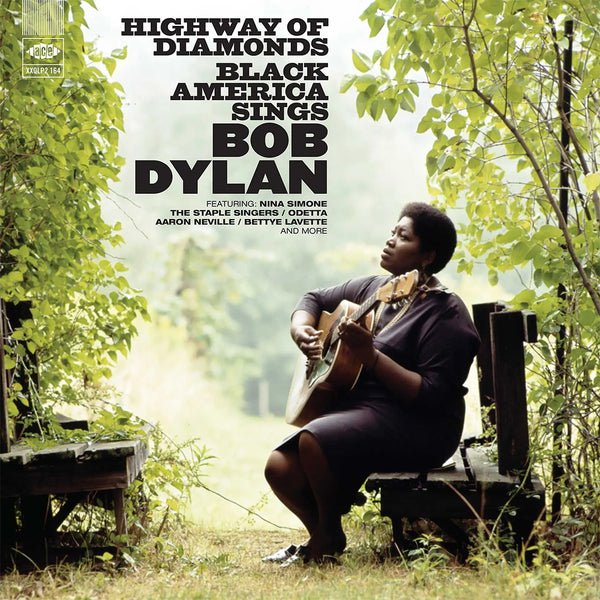
Earlier this year, interested listeners were treated to “Highway of Diamonds: Black America Sings Bob Dylan,” a collection of 20 Dylan-penned tracks interpreted by Black artists over the last half-century.
It’s the eighth record in the “Black America Sings” compilation series released by Ace Records, a UK label that took its name from a now-defunct 1950s recording company in Jackson, Miss. (the former company’s records are now part of the Ace UK catalog). A previous collection of Dylan covers, “How Many Roads: Black America Sings Bob Dylan,” kicked off the series in 2010. Other entries focus on the music of the Beatles, Otis Redding and Sam Cooke, among others. A collection of Stevie Wonder interpretations is forthcoming.
“Highway of Diamonds” polishes several hidden gems released commercially between 1965 and 2017 and really speaks to the pervasiveness of Dylan’s ability to create “new poetic expressions within the great American song tradition,” as the citation for his 2017 Nobel Prize in Literature reads.
I won’t try to put the album’s emotional resonance into words. Just go listen to it.
Nina Simone singing, “Just Like Tom Thumb’s Blues.”
Harry Belafonte singing, “Tomorrow is a Long Time.”
Aaron Neville singing, “Don’t Fall Apart On Me Tonight.”
Every track is a discrete treasure.
“Ace has a long history of bringing artists that other labels wouldn’t have run into,” Baylor University Emeritus Professor Robert Darden told me. “This is extremely well curated. Some of these are absolutely new to me. What a fabulous compilation.”
For music of this type to be new to Robert Darden is quite a statement. Darden was Billboard Magazine’s gospel music editor from 1984-1998, founded the Black Gospel Music Preservation Program at Baylor, and has written some two dozen books on related topics. We caught up last month while he was in Oxford Town to moderate a moving program called “Free Speech, Freedom Songs, and the Music of Liberation” at the Overby Center for Southern Journalism and Politics, where we both serve on the center’s panel of experts.
Sitting together in my office, I shared a printed copy of the “Highway of Diamonds” track list and asked for his unvarnished reactions.
“I just think of all the major folk acts, he’s as natural to include and celebrate as anybody, and you hear it when you hear gospel artists sing his songs,” Darden said. “Dylan does as much as anybody in my mind to keep celebrating that.”
He’s certainly not wrong. As this Salon review of “Highway of Diamonds” notes, Dylan has a long, storied and reciprocal relationship with Black America and its entertainers. Aside from Woody Guthrie and Buddy Holly, many of Dylan’s earliest musical influences were Black, and he has long exhibited a reverence for Black artists and culture.
“His music at its best is universal, but comes from a place, as he did, of singing the music of marginalized people,” Darden said. “He may be a multimillionaire now, but his songs certainly for so long have resonated with the people who played them and who listened to them among African Americans.”
As a high school senior, Dylan’s career ambition was, according to the school yearbook, to “join ‘Little Richard’” as a professional recording artist. He’s written extensively about the importance of Leadbelly, Charley Patton and scores of other Delta bluesmen in helping him develop his own “thin, wild mercury” sound in the 1960s, too. In his 2001 memoir, “Chronicles: Volume One,” here’s how Dylan recounts the moment Columbia Records producer John Hammond first played him a Robert Johnson record:
From the first note, the vibrations from the loudspeaker made my hair stand up. The stabbing sounds from the guitar could almost break a window. When Johnson started singing, he seemed like a guy who could have sprung from the head of Zeus in full armor. I immediately differentiated between him and anyone else I had ever heard.
But the relationship goes beyond the blues. Dylan also draws heavily from the Black gospel tradition. “Blowin’ in the Wind” takes its melody from a traditional spiritual, “No More Auction Block.” Other songs in his folk canon do, too.
When he entered his “Born Again” Christian phase in the late 1970s and early 1980s, he sought out producer Jerry Wexler and recorded two of his three gospel-tinged albums at Sound Studios in Muscle Shoals, Ala., with Black backup singers filling out the harmonies. The hard-right turn in his lyrics alienated a lot of his folk-rock fanbase at the time, but the music itself holds up really well.
“You know, I don’t want to sound like a Christian apologist, but I think there’s some extraordinary music on all three of those albums,” Darden said.
During the same period, Dylan was married, briefly, to gospel singer Carolyn Dennis—one of the backup singers mentioned above—and the two share a daughter.
Dennis wasn’t his first interracial love interest, either. He courted Mavis Staples in the 1960s, even proposing marriage, but she turned him down. After meeting African American SNCC activist Dorie Ladner at a voter registration rally in Greenwood, Miss., in July 1963, the two spent many evenings together in New York City later that summer in the lead-up to the March on Washington. He speaks of her in “Outlaw Blues” when he sings:
I got a woman in Jackson
I ain’t gonna say her name
She’s a brown-skin woman, but I
Love her just the same”
As Darden and I chatted, we moved through these topics rapidly. Though he’s officially retired, he continues to be involved with the growing gospel preservation collection at Baylor.
“Last month we passed our 70,000th item digitized,” he said. “We’ve got more gospel music than the Library of Congress, which is both good and bad, that they didn’t think it was worth doing. But at the same time, I’m glad it’s saved.”
In summarizing Dylan’s relationship with Black America, Darden says the proof is in the quality of the music.
“To me, because it’s in his DNA, some of his best interpreters are African American artists,” Darden said. “Like Jimi Hendrix’s ‘All Along the Watchtower.’ He gets the inherent drama of it that other would-be interpreters—that’s his song, you can’t top that.”
To his ear, “Highway of Diamonds” captures that legacy, and continues it.
“Go back and listen to the original ‘All Along the Watchtower,’” he said. “Then listen to Hendrix. Go back and listen to Shirley Caesar’s ‘Gotta Serve Somebody.’ And it’s better. Because of that DNA, he can give it over to them, because a lot of these songs have a lot of space between the lyrics. A lot of his songs have that space for a Mark Knoffler to breathe, etc. In my mind it's logical and natural, and I’m just so delighted to see [this album].”
Aren’t we all, amen.
–––––––-––––––––––––––––––––––––––––––––––––––––––––––––––––––––––––––––––---
R.J. Morgan is instructional associate professor in the School of Journalism and New Media at the University of Mississippi, director of the Mississippi Scholastic Press Association and a member of the Overby Center panel of experts.
