
Rev. John Perkins faithfully lived his teachings on forgiveness and reconciliation
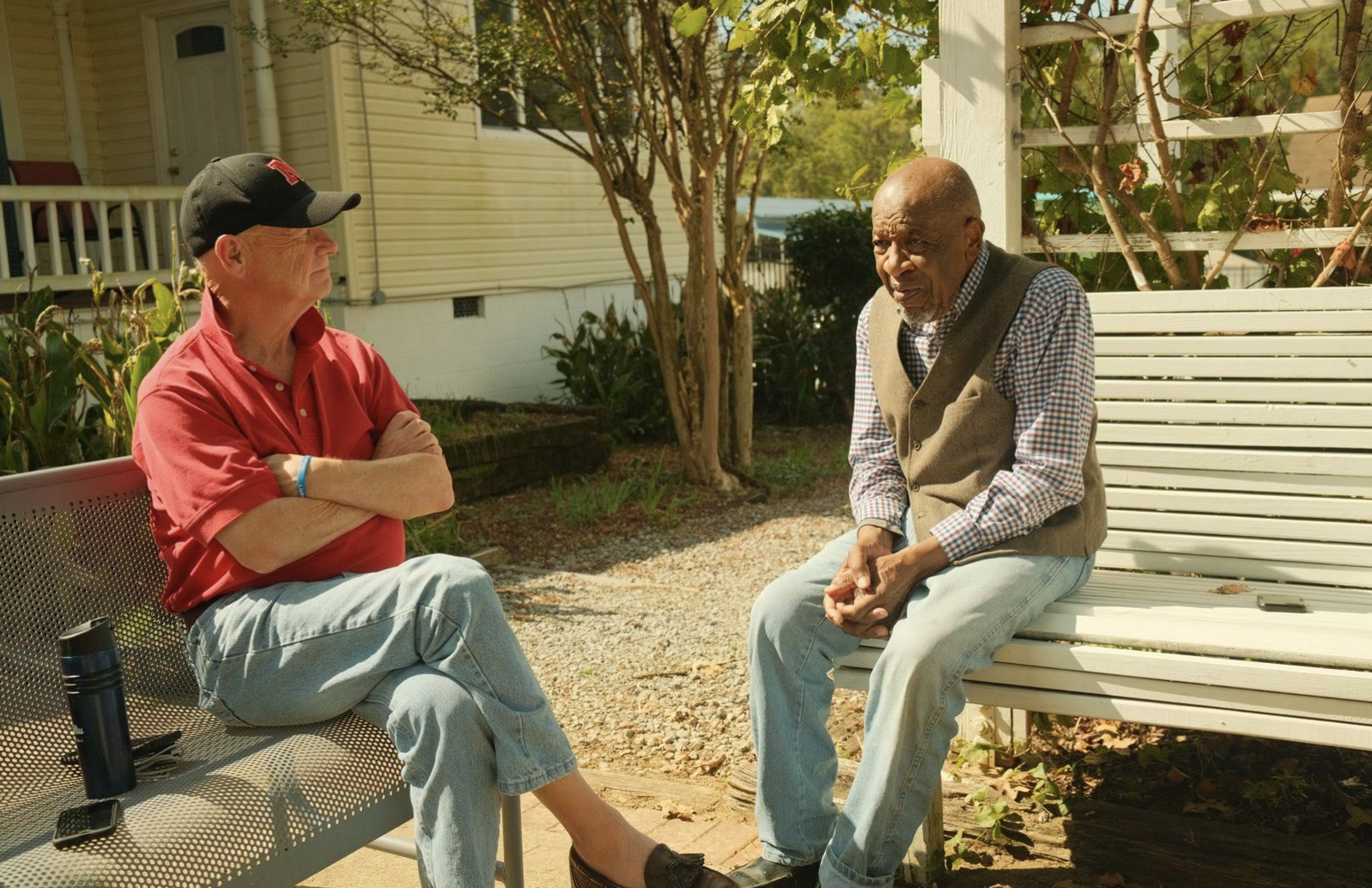
Will Norton visits with the Rev. John Perkins in 2021. Photo by Will Acuff, CEO of Corner to Corner, Nashville, Tenn.
By Will Norton
The Rev. John Perkins and I went into a shop on the outskirts of Jackson, Miss., during an afternoon in June 1970. John’s driver came with us.
John walked up to the counter, but nobody was there.
After a few minutes, the owner came out of a backroom.
“What can I do for you, boy?”
I heard him say “boy,” but I didn’t understand what he meant.
John was 40 years old, had a gorgeous wife and children.
John didn’t answer.
He just stepped back, and the white staff person told the owner what John needed.
I had never seen such an incident.
“What was that all about?” I asked when we were back in the car.
“It’s saying I’m not equal to him.”
I thought of that incident last Friday morning, March 13, when John went to be with the God he knew so well. His family was with him in those last moments. He had been in hospice care since Feb. 24 and had moved home after release from the hospital.
The Rev. John Perkins was 95. The New York Times paid tribute to his life and accomplishments with a fully detailed obituary published on Sunday, March 15. The City of Jackson will honor Perkins as he will lie in state in City Hall from 10 a.m. until 4 p.m. Friday. Services will be Saturday, March 21 at 11 a.m. at New Horizon Church International in Jackson.
* * * * *
I had learned about John when I was managing editor of Christian Life magazine. A missionary had visited our offices in Wheaton, Ill., to express his appreciation for our coverage of the Rev. Tom Skinner’s and the Rev. Bill Pannell’s meetings in Newark, NJ.
The missionary said he was about to begin a speaking tour of the country and would let us know about any evangelicals who were working on civil rights issues. A few months later, he told me about an evangelical minister who had led a boycott in Mendenhall, Miss.
At that time, few evangelicals were involved in the Civil Rights Movement. They essentially took the position that civil rights efforts were inherently political, and people of faith were not to mix their faith with politics.
So, this was a story.
I left Christian Life in May 1970. So I wrote John, and he agreed to an interview in Mendenhall.
He and Vera Mae met me at the airport. I slept in their guest house and, for nearly two days, I talked with John and his colleagues and attended community meetings where he spoke.
I learned that his ministry was the journey from the Brandon, Miss., jail. Brandon is a suburb of Jackson and the county seat of Rankin County. How he responded to torture in that jail established the direction of his life and the lives of hundreds of thousands of those with whom he ministered.
The Mississippi Highway Patrol had arrested him and beaten him with a blackjack. They bent the middle prongs of a fork and shoved it up his nose. When the state law officers heard the FBI was coming to the jail, they made him mop up his own blood. Then they learned that the FBI was not coming, and they beat him again. He lay on the floor, unable to move, and the officers went about their business. When they walked past him, they would kick him as he lay there.
John said the Mississippi Highway Patrol was the information system for the Klan and that a patrolman had been in Mendenhall checking out the boycott demonstrations. Students from Tougaloo College, a historically black college in Jackson, had been a part of the activities. When they were returning to the college, they were stopped by the highway patrol and taken to the Brandon jail.
John learned of their arrest and drove to the jail. He was arrested in Brandon, and about a dozen highway patrolmen tortured him.
“I was so angry,” he told me. “If I had had a grenade, I would have blown the place up. As I thought about my anger, I realized that I was just like those highway patrolmen. The answer is not anger.”
When I heard this, I thought John was wrong. He was accepting injustice. He was guaranteeing oppression.
But, at the end of two days, in that photo shop on the edge of Jackson, I saw his strength. I didn’t understand the dynamics until we were back in the car and headed for the airport.
“Why didn’t you get angry?” I asked.
“That would not have helped,” John said.
* * * * *
I have met with John at least twice a semester since 2009, when I returned to Mississippi. We have had long conversations.
“If I had been stronger,” he told me, “I never would have led a boycott.”
That was another statement of strength. Getting people to reconcile their differences was John’s mission.
It had to do with forgiveness, something I had been taught by my parents, but I just could not tolerate injustice. I would get angry and say things I should not say.
In the last few years, he told me about several difficult situations related to race, and I understood.
“I can’t ever really know what life is like for people of color, can I?” I asked him.
His face lit up. “That’s right.”
As an African American, he lived a life impossible for a white person of privilege to understand. His life’s work was to break down barriers that had created that lack of understanding.
* * * * *
John is famous. He is known all over the world. He has met every U.S. president from Jimmy Carter to Barak Obama.
However, when I was in a humiliating situation in 2020 and few people would talk with me, he took the time to meet. He also would call me at least once a month to encourage me to remember those who had accused me and forgive them.
“You and I are broken,” he would say, “but God continues to forgive us. We’ve got to forgive.”
At Christmas time, during my last visit with him, he went into a monologue with me and the waitresses in a restaurant southwest of Jackson.
He kept returning to the phrase, “Good News, great joy, for all people.” Then he would elaborate.
As he spoke, I realized that lawmen beating him in the Brandon jail was no big deal for John. What was important was that they knew forgiveness.
On the road from the Brandon jail, he was committed to reconciliation. It is what he was looking for that afternoon in the shop on the edge of Jackson. It is what he communicated to me for 56 years. In the last few years, during my personal anguish, he reminded me month after month.
John taught me many things. The most significant was that reconciliation is important, and we cannot have reconciliation if we do not forgive.
For John Perkins, reconciliation was “Good News, great joy, for all people.”
-––––––––––––––––––––––––––––––––––––––––––
Will Norton is senior fellow emeritus at the Overby Center for Southern Journalism and Politics. He is dean emeritus at the University of Nebraska-Lincoln School of Journalism and Mass Communication and former dean of the School of Journalism and New Media at the University of Mississippi.
More on John Perkins:
“John Perkins, the Stature of a Servant” <https://www.christianitytoday.com/1982/01/john-perkins-stature-of-servant/>
“An Interview with: John Perkins, the Prophet” https://www.christianitytoday.com/1982/01/interview-with-john-perkins-prophet/
Rev. Perkins was profiled previously after his 93rd birthday by Will Norton on the Overby Center website.
