
Cuts at Washington Post create a news desert at the highest levels of journalism
By Ronnie Agnew
For top managers in the thick of it, the downsizing of America’s newspapers began aggressively in 2008 when the economic downturn forced many of us sitting in executive editor seats to make difficult decisions. We were left with no choice. Advertisers were pulling back and revenue that used to keep our papers filled with news and the staff to produce content simply went away.
Of course, there were other factors. In those early days of cuts, I saw it as my job to keep as many of the seats in my newsroom filled as possible. That, too, was a difficult task, as word from corporate managers often took such decisions out of my hands. Despite it all, my team fought to give the public the best coverage we could with whatever staff remained.
Admittedly, the industry was caught flat-footed as retailers found other ways to reach customers and newspapers were no longer indispensable in what was once an ironclad business partnership. The digital age, which vastly accelerated the availability of news, quickly changed consumer consumption habits, delivering a double whammy to an industry that had become stuck in its ways and slow to change.
As the person in charge, the cuts were painful, and it was impossible not to take them personally, often leading to sleepless nights. It was about the pursuit of great journalism and the dissemination of information for those of us committed to this great industry and willing to devote untold hours to it. We’ve long passed the jarring reaction resulting from early staff reductions, and the newsroom cuts have become common, reaching unfathomable, if not predictable, levels.
That is until recently, when many in the industry were stunned after learning of steep layoffs at the venerable Washington Post. The size of the reductions, 33 percent of an already smaller staff, still elicits shock that’s hard to put into words. It’s the Post I’m talking about, a gold standard in American journalism, a perennial Pulitzer Prize-winning newspaper with many years of sustained excellence, not to mention big-name journalists who delivered many of this country’s most historic stories.
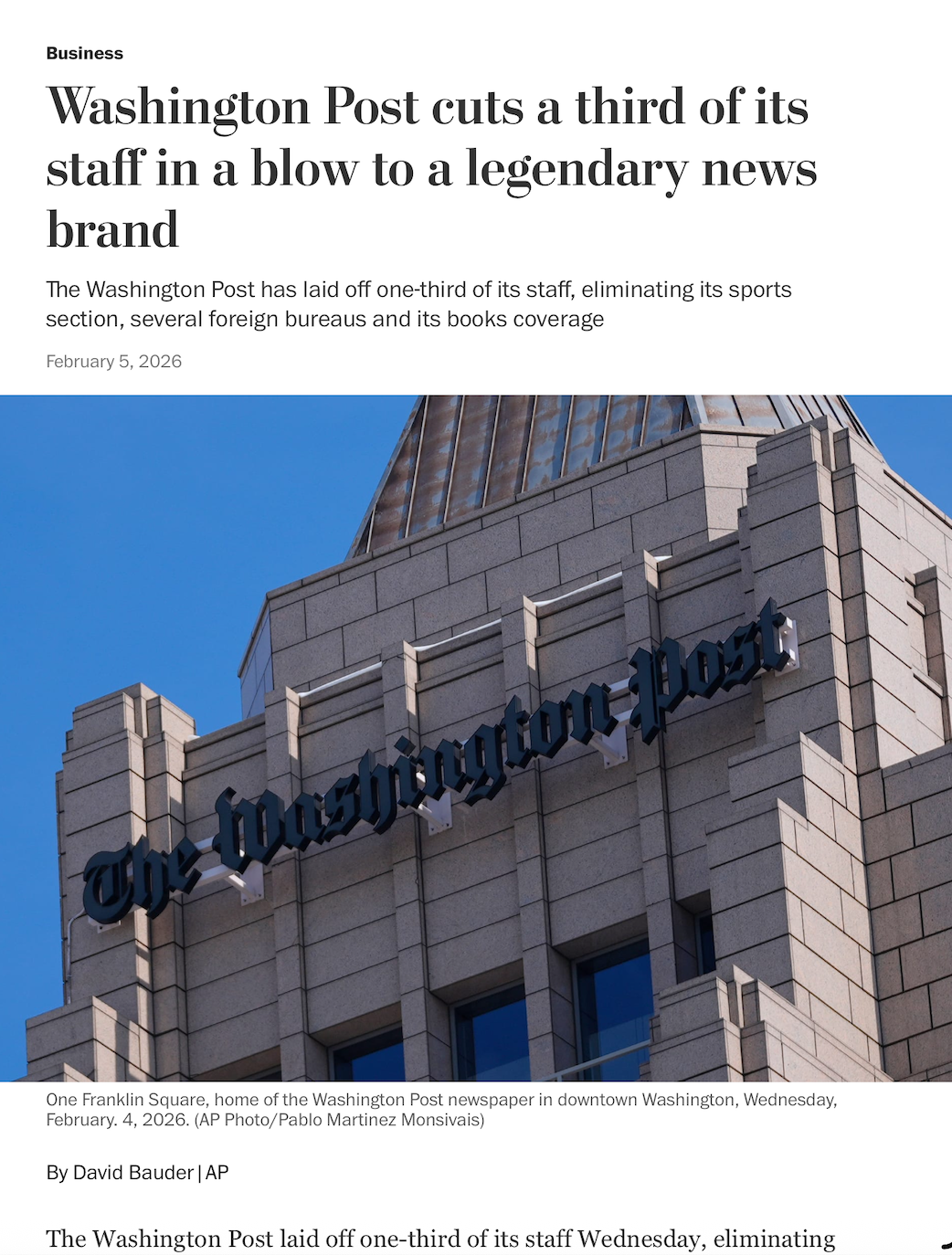
The Washington Post laid off one-third of its staff. Photo from The Washington Post.
Local communities were first to see thinner newspapers and incomplete news reports resulting from cutbacks. With the loss of tens of thousands of journalism jobs since 2008 that’s hardly surprising. But the Post? Despite layoffs in recent years, the size of its staff remained large enough to produce a magazine, aggressively cover local news and sports, keep important foreign bureaus open, and certainly give its loyal readership an opinion page which held power to account without management interference. In early February, that all changed, and our industry is likely weaker because of it.
Amazon founder and Post owner Jeff Bezos, one of the world’s richest men, is widely blamed for ordering the potentially crippling reduction. Media reports indicate layoffs amounting to one-third of the staff, raising legitimate questions about a future with hundreds of empty seats. Many of the nation’s journalists and readers viewed the Post with reverence, a distinction earned over decades extending beyond Watergate and the Pentagon papers. The Post has long been a damn good newspaper worthy of the respect it has been given. But these recent cuts, which include the elimination of foreign bureaus, the sports department and other sections, ensures a product that leaves readers in the dark and fertile journalism ground that cannot be accounted for. A news desert has been created at the highest level of journalism, at a time when the nation is engaged militarily.
According to The New York Times, the Post eliminated 300 of its remaining 800 positions, including its highly respected books coverage and local news positions. On Facebook, award-winning journalist Marty Baron, the Post’s executive editor until 2021, summed it up as only an insider could. “This ranks among the darkest days in the history of one of the world’s greatest news organizations.”
Baron wasn’t done. He told a PBS news anchor that “I think it's important to keep in mind just how widespread these cuts are, not only the sports desk, the books department, but pretty much the entire arts department, eviscerating the foreign staff, largely eviscerating the local staff as well. So these are huge, huge cuts, and they're going to be – they're going to do enormous damage to the newspaper's ability to cover its community, to cover the country, and to cover the world in all the ways that it should.”
The latest downsizing follows a series of changes that may have been an indicator of things to come. In 2022, elimination of the paper’s widely revered magazine was widely panned, but its shuttering was just the beginning of more alarming decisions. The Post’s credibility and position among journalism’s elite took a major hit in 2024 with Bezos’ demoralizing edict that the opinion page scrap its presidential endorsement of Kamala Harris. It was universally blasted by Post opinion writers and Baron, who called the decision, made 11 days before the election, “cowardice” and “gutless.” Canning the endorsement was soon followed by the decision that the opinion page would take a more conservative approach, which many attributed to Bezos’ growing friendship with President Donald Trump.
Without question, the industry is in the throes of its elusive struggle to find a viable business model. The Post’s financial losses reportedly reached $100 million in 2024. However, when he first purchased the newspaper in 2013 for $250 million – a fraction of what it was once worth – Bezos said he would support journalism and encourage innovation. The cheers from that pronouncement have now turned to jeers, and the billionaire’s hollow pledgeof providing financial support in what he knew was a changing industry has been met with scorn. Will Harris, the Post’s former publisher/CEO, recently resigned and perhaps deservedly is widely criticized for his perceived ineptness and refusal to protect the newsroom from an aggressive owner guided by the unprofitable spreadsheets he once downplayed.
Staff members have walked and so have subscribers. After the Harris endorsement was pulled, the Post reportedly lost 250,000 subscribers. Reports since the massive cuts indicate the paper continues to lose paying customers. Meanwhile, The New York Times is experiencing increases. The Times’ staff is holding steady with a newsroom of about 1,500 journalists. The number of subscribers, most of them digital, is estimated at nearly 13 million, much larger than the Post’s estimated 2.5 million subs.
Kevin Blackistone, a lifelong journalist, author and Washingtonian, admits that he is taking the cuts personally. He delivered the Post when he was a kid, the beginning of a long association with his hometown paper. As an accomplished journalist, he’s written a sports column for the past 10 years that was published in the Post, ending last year.
“The paper was a public trust. It wasn’t just a business for the Grahams,” he said in an interview, referencing Katherine and Donald Graham, the former owners of the newspaper, celebrated for their commitment to upholding high journalistic standards.
“Jeff Bezos is dismantling the paper. He’s gutting the very things that made it The Washington Post,” Blackistone said. “They’ve basically eliminated the metro section and the sports section. Who’s going to cover the city now? The paper is a shadow of its former self. It’s diminished and the loss is felt by everyone in this town.”
Close observers, and there are many, have for years watched intently as the Times and Post competed on the national and international stage, each counting the number of Pulitzers as a metric to validate their journalistic prowess. As a four-time Pulitzer judge, I well remember the fierce battle for dominance the two fought for all the right reasons. It was about the reader. It was about exposing wrongdoing. It was about building an informed populace by providing information not available elsewhere.
This staff decimation changes everything, although it is a certainty the remaining Post staff will not simply roll over. What will be missed is not the obvious news that is widely disseminated, the kind usually covered by the pack, otherwise known as members of the Washington press corps. It will be the stories that require investigation and source development that will go untold due to staffing gaps that no longer make revelatory, often time-consuming stories possible.
Is this the end of journalism as we know it? Significant change began years ago when economic conditions placed an all-consuming emphasis on the bottom line. While a blow to the industry, however, I believe America’s story will continue to be told by committed journalists from media of all sizes dedicated to uncovering truth. No misguided owner can kill swagger, as former Post sportswriter Sally Jenkins recently wrote. But a diminished Post, at a time when its strength is needed most, will necessitate a recalibration. Its devastating impact to the industry does not signify the end of high-level journalism. With fewer journalists, it just makes the job more difficult.
————————————————————
Ronnie Agnew is a longtime editor and news media executive and a member of the Overby Center panel of experts.
