
With Black journalists in decline, a new type of news desert is emerging
By Ronnie Agnew
The National Association of Black Journalists recently held its annual meeting in Atlanta, a highly attended affair that brought out seasoned journalists and early career ones. Throughout NABJ’s history, the conference has embraced the importance of providing educational support for the journalism industry’s largest minority organization, particularly now in an industry shrouded in uncertainty. NABJ has long been a much-needed support group. Its national conference tackles serious topics, but just as important is the family reunion feeling among attendees who share deep commonalities. At NABJ, no one is a stranger.
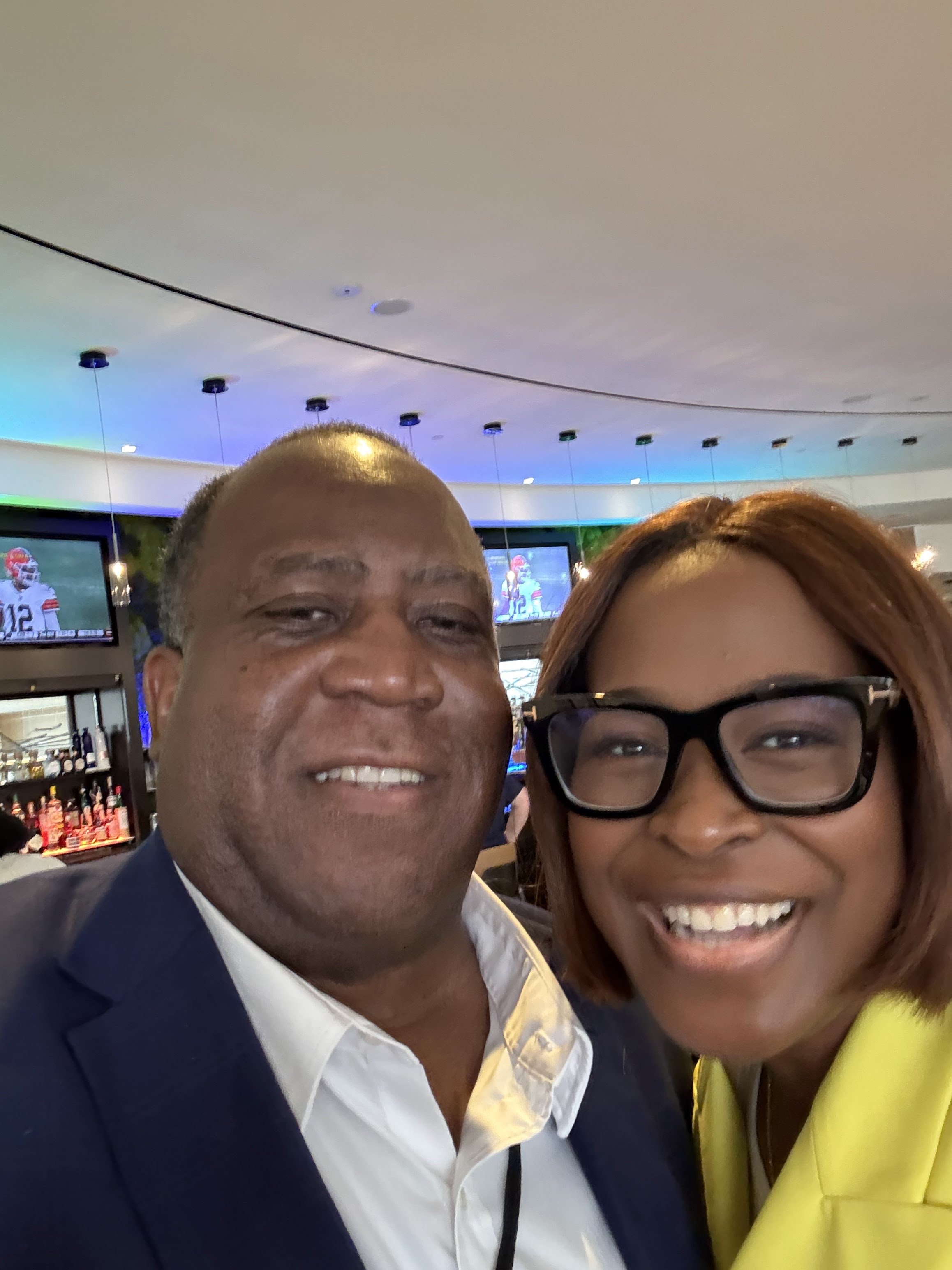
Ronnie Agnew and Errin Haines, president of the National Association of Black Journalists.
The conferences typically have some measure of controversy, and this year was no different. An unopposed vice president candidate was disqualified from running for office after NABJ rules determined she wasn’t a full-time journalist. Stephen A. Smith, the popular ESPN sports personality, was given a “Thumbs Down Award” for alleged “disparaging commentary” of Black women in high political positions. Smith has a separate show delving in politics that is not associated with ESPN. The fallout from Smith’s award wasn’t pretty and, though a bit part of the conference, it received more national attention than it deserved.
In full disclosure, I met with many friends and industry leaders at the conference but wasn’t registered for this year’s meetings. It wasn’t my best decision. I witnessed the excitement on the faces of friends and colleagues, who relayed to me that this year’s programming was well worth the registration fee. More than 4,000 NABJ members were witnesses to it.
As everyone settles down and returns home, I can’t help but think that, despite the happy gathering, challenges lie ahead for Black journalists. NABJ leaders certainly know what they’re up against. One of my top concerns is one of numbers, as in layoffs, the impact of AI, and what corporate priority shifts will mean. Despite a dire need, the number of minority journalists continues its alarming descent, especially in top positions. Journalism’s corporate leaders find themselves in survival mode, and well-intentioned efforts to ensure newsroom diversity have taken a backseat to shrinking bottom lines. Changing industry priorities shouldn’t come as a shock. Newsrooms have gotten smaller regardless of race and companies’ once firm commitment to diversity, equity and inclusion has long faded.
Diversity has been problematic in the media industry for decades, both in print and broadcast operations. In the 1980s, 1990s and early 2000s, bringing racial parity to newsrooms seemed an important concept, albeit a difficult one. In these modern days, NABJ and other minority journalism groups should be applauded for staying in the fight, using conferences like Atlanta to arm young and mid-career journalists with tools for success. The journalism groups remain trusted resources despite threats that even they can’t ignore.
But facts are facts. Only 6% of journalists at America’s approximately 1,200 newspapers are Black, despite Black people making up 12% to 13% of the U.S. population. That’s a paltry number that seems stuck in neutral and unlikely to be advanced. I must confess that I consider this topic personal for reasons of guilt I can’t seem to shake. Until the end of 2025, I was one of those editors leading a newsroom. But I made a decision that surprised even me. While I will never fully leave the profession, I made the decision to leave daily journalism. I decided to put a “pause” on a career that has spanned 41 years, persuading myself that it was time for a break.
When I read pieces on the absence of Blacks in newsrooms, I worry about what this means. It causes me to think about diversity’s role in producing a more complete news report and the importance of having diverse voices at the table. The “table” is a place where decisions are made and people of varied backgrounds add richness to content by bringing themselves, their unique ideas, and cultural nuances to work.
“The absence of Black journalists doesn’t just harm us, it impoverishes the entire profession,” NABJ President Errin Haines told a publication focusing on Black audiences. “When our voices are missing, stories go untold, perspectives go unchallenged, and the truth remains incomplete.” Haines works for The 19th, a nonprofit news organization covering gender, politics, and policy.
I considered my background as a son of sharecroppers who went on to work in Mississippi manufacturing plants as valuable talking points when discussions centered on hard-working citizens struggling to make ends meet. My journalism education, often learned by experience, would ultimately lead me to cover powerful politicians and CEOs of big companies. As a content creator, it was important to reach audiences of all types, from people society deemed important, to others who felt they have no voice. Diversity helps to bridge those gaps.
Journalism can be difficult to explain. Those in the industry know what I mean. We feel called to this profession, and we feel a responsibility for the truth we report, which separates us from social media reports that often take unfactual leaps many dangerously accept as truth. With everything that’s in us, those who do it right take journalism's mission to inform seriously. But as diversity wanes, so does a part of America’s story. That is not to say that good journalists of all races can’t cover topics involving minority communities. The truth is we need journalists who provide a voice for the voiceless, who understand the needs of specific communities, bringing depth and needed perspective. The alarmingly low number of Black journalists is bad for contextual journalism, bad for communities who feel left out, bad for an informed populace.
Who’s left to tell the story on how Black communities feel about the mid-term elections? I get the point when I see a compromised Supreme Court significantly dilute the Civil Rights Acts of 1965, clearly showcasing an absence of thought, or care, in creating a racially divided America. I get the point when I see several Southern states racing it seems to change congressional districts in an attempt to minimize Black representation at state and federal levels. I get the point when the president of our country pressures Republicans to pass the SAVE Act, legislation that would unquestionably make it more difficult for disenfranchised people to vote.
Those issues and many more demand a range of views from diverse journalists, including Black journalists, with the ability to explain the impact for specific audiences. But they need to have a seat at the table and the courage to say what might not get said. There are great journalists of all colors. However, during the years when diversity seemed to matter, this was exactly the point: that journalistic representation from diverse communities would lead to a more thorough and accurate news report.
Journalism is not an easy profession. In fact, it’s probably never been harder. Newsrooms are experimenting with AI and how it ethically fits into their news reports. The battle to secure subscribers has never been more intense. Revenue models that were torn apart more than 15 years ago still have not been rebuilt and perhaps never will be. One would hope that the importance of diversity would make this list of priorities, but even I am doubtful it will receive that level of attention. With a decreasing number of Black journalists, another kind of news desert is emerging – and it has nothing to do with geography, but everything to do with an industry in turmoil.
————————————————————————
Ronnie Agnew is a longtime editor and news media executive and a member of the Overby Center panel of experts.
