
Q&A with Peter Imes
By Antonella Rescigno
Editor’s note: This interview was conducted on August 28, 2026 and has been edited for clarity and brevity.
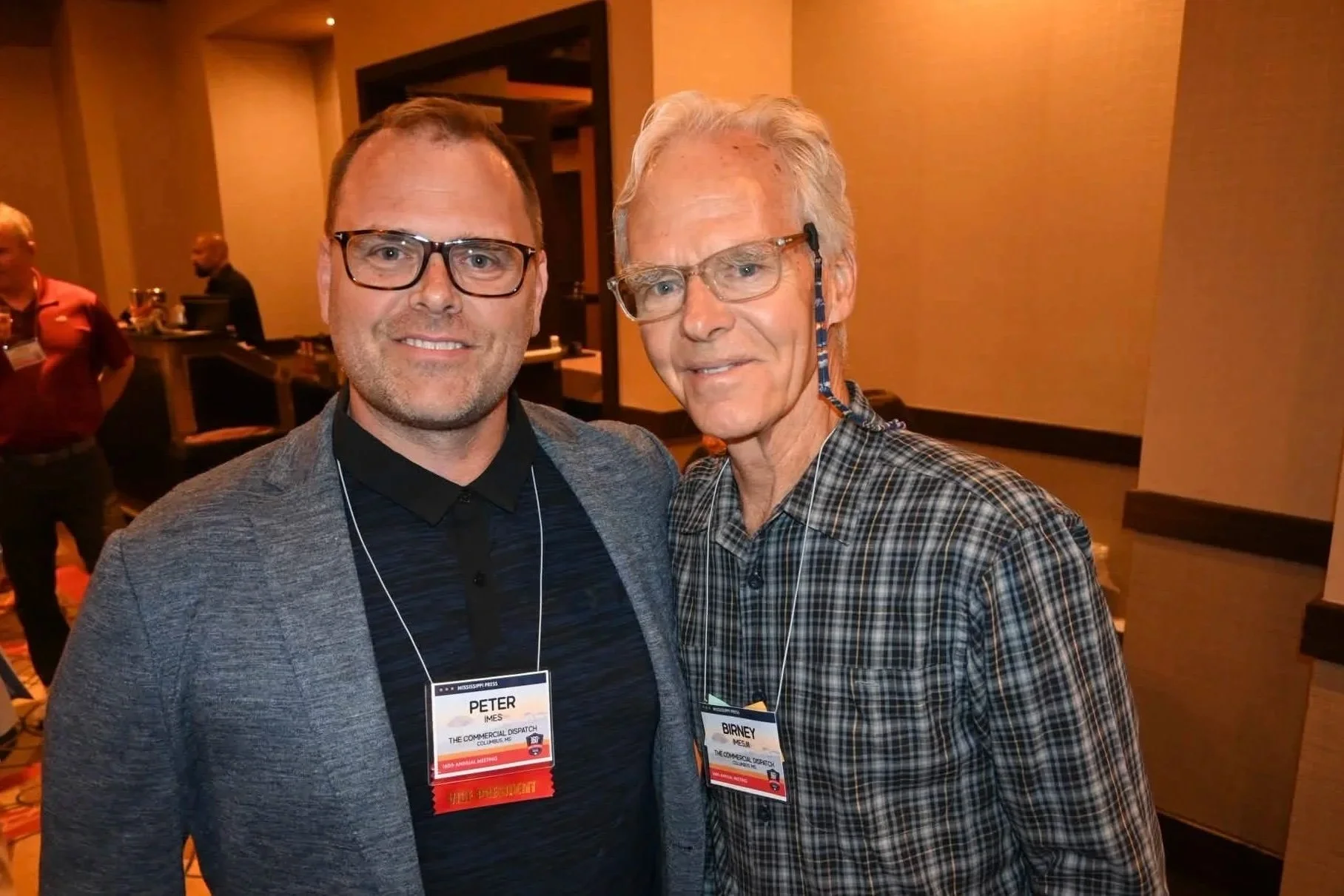
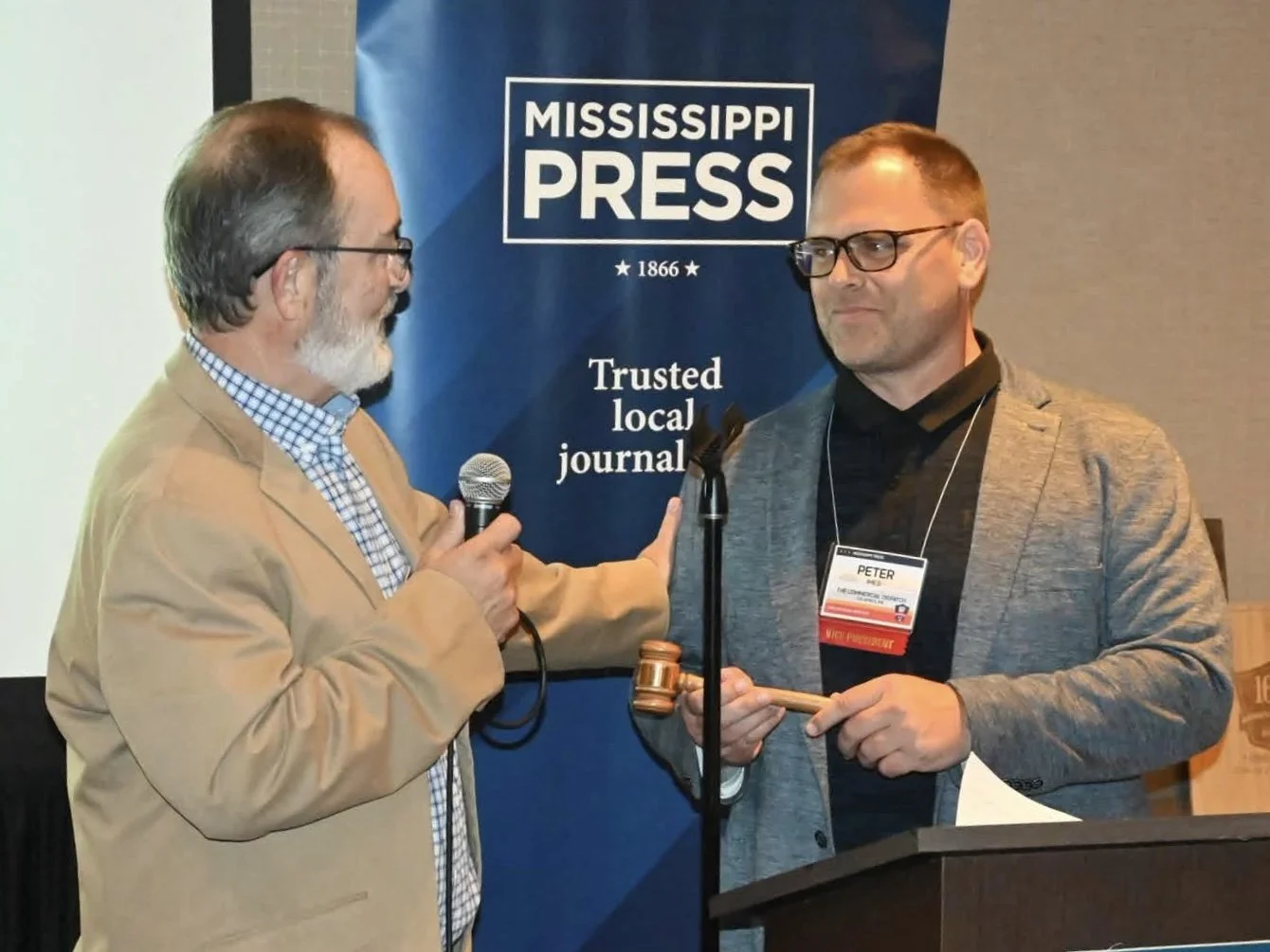
Peter Imes is the editor and publisher of The Commercial Dispatch in Columbus. He is the fourth-generation publisher of the newspaper, which is Mississippi’s only family-owned daily newspaper. Imes was elected president of the Mississippi Press Association Board of Directors for 2026-2027 on Aug. 4.
Imes was born and raised in Columbus. He took classes that he was interested in at Mississippi State University and the University of Texas at Austin, but he did not graduate. He entered the workforce early on.
The Commercial Dispatch has been a family-owned newspaper since its first edition consolidated newspaper was published in Columbus on March 12, 1922 by Vinton Birney Imes Sr., its editor and publisher. Birney Imes had been in the newspaper business for 12 years before he purchased The Columbus Dispatch from the Maer family and merged it with The Columbus Commercial, which he purchased in 1921.
In an exclusive Q&A with the Overby Center for Southern Journalism and Politics, Peter Imes shares his insights on the current state of journalism, the rise of artificial intelligence, and journalistic objectivity.
Q1: As the editor and publisher of The Commercial Dispatch, what are some of the biggest challenges you see in the newsroom, and how do you address them?
A: One of the biggest challenges about the newsroom as it relates to the community is that we have an emphasis on reporting on local news. But what we have been seeing over the past couple of years is that our national and international news reporting has affected the way that our readers view our local news. Specifically, I'm talking about the kind of partisan nature of politics right now. Even though our emphasis is reporting on local issues that relate to everybody in the community and affect everybody in the community, we can write, or we can run one Associated Press story about Donald Trump and really alienate a lot of people. So, that's been a challenge, and we've been working within the newsroom about how to combat that. It's interesting, I mean, and we still have readers, probably more on the print side than on the digital side. Our print product is still really strong. We publish a print product five days a week and a lot of those readers still rely on the newspaper for national and international news so we can't just get rid of it completely, or else it will upset our print readers.
Q2: Can you talk about some initiatives or practices that The Commercial Dispatch has implemented to strengthen the transparency toward your audience?
A: I think historically newspapers have not been really good at explaining what they're doing and why they're doing it and so we try to be really conscientious about that. Specifically when it comes to open records requests or open meetings challenges, we try to educate the public on why these things are important to us.
When we make mistakes, it's important that we give a complete correction or clarification to what we got wrong, and we try to be open with the readers about that as well. One criticism we heard frequently was that our corrections were always buried on, like page three of the paper, and people said, you made the mistake on the front page. Why is your correction on page three? So we thought that was a valid complaint. And about three years ago, we started publishing all of our corrections on the front page so we were front and center with it.
Q3: The relationship between advertisers and news outlets has changed dramatically. How do you balance business pressures with journalistic integrity?
A: We've always kept a really strong firewall between advertisers and the newsroom, and I think that's a culture and an understanding. We've been here since the late 1800s and I'm not saying we've done that for the entire history, but definitely for the past 20 years or so, at least. I think we've built a culture and an understanding that advertising does not buy you coverage and does not buy you a favor. However, we are running a business also, and so sometimes it's a fine line. I think, especially with a lot of newsrooms now looking toward philanthropy, there's going to be an added layer of that. There's more and more newsrooms that are looking at grant funding opportunities and there are similar potential conflicts of interest there as well.
Q4: What inspired you to pursue a career in journalism?
A: I was kind of born into it, I grew up thinking that I would never work at the newspaper or the TV station. We were in multiple types of media and I had zero interest in it, and pursued a career in tech and then in real estate. Then once I started a family, I moved back home to Columbus and just started taking on small projects at the paper, redoing their website to start with and slowly just working my way into it and kind of developed a love for it just by doing small projects here and there.
Q5: Throughout your career as a journalist, what accomplishment or moment are you most proud of?
A: The accomplishments that I'm most proud of are staffing accomplishments. I am not a fantastic journalist, but I think I am really good at finding talented people and letting them do their thing. On a personal level, that's what I'm most proud of. We've got an incredible team here on the newsroom side, on the advertising side and on the customer service side we've got great people. Those are the folks that allow us to have any successes that we have in terms of awards and that type of thing.
Q6: Artificial intelligence is rapidly entering the newsroom. How do you see AI affecting journalism and how is The Commercial Dispatch responding?
A: Big picture, I think AI is going to go a long way towards saving journalism, especially on the local level. AI is an incredible tool that can empower really small newsrooms to do more with less resources. I think that's the challenge, especially in a state like Mississippi, where you've got a lot of newsrooms that are made up of just one or two people, they're wearing so many different hats. AI agents, I think, over the long term, stand to fill in a lot of gaps there and help make the life of a one- or two-person newsroom operation a lot better. There are a lot of reasons we use it here. We're very careful about how we use it, we've got a defined policy, we disclose when we use it in print. We do use it for sorting through, for example, large legal documents. If we download a legal complaint that's 200 pages long, it's a lot more effective at sorting through that complaint and calling our attention to things that we need to pay attention to than we are. It helps us get up to speed. One of the unique things is we have to become experts in a subject really quickly. If we're doing a story on beef like we were this past week, how are local beef farmers reacting to the import of Argentinian beef into the U.S.? We've got to get up to speed on that really quickly. We've found that AI is really good at teaching us what we need to know to be conversational on a subject. We use it in very limited ways now. We don't use it to generate content directly, but we do use it if they (reporters) are stuck in transition or they're stuck with one particular aspect of the story. We encourage them to experiment with AI, but we also encourage them to be open about it. We don't try to build shame around it because I think when you build shame around it, it's such a powerful tool and it's so alluring, and we don't want to make people feel guilty that they leaned on it. We would rather be open about it and as a newsroom have a conversation about why that's an okay use of AI or maybe why it's not. The shame is dangerous, if you keep it secretive and to yourself, and we've seen this play out in the newsroom. Somebody might use it for something small and it works really well, and so they use it for something a little bit bigger to write, maybe a full paragraph, and then maybe it's a whole section, and then maybe it's writing an entire story. If you're not open about it and having those conversations, I think it creates an environment where stuff like that can get out of control.
Q7: What do you think journalism schools should emphasize in their teaching today? Are there skills you believe are missing from current curricula?
A: I don't know if I'm qualified to answer that question. I didn’t go to journalism school myself. I'm not comfortable enough with the actual curriculum in schools, but from an employer standpoint, what I see coming out of schools, it's not as bad now as it was a few years ago. But some schools say we need short-form video or we need long-form video or we need to be on this particular platform. And to me, those are good. I think you need training on how to use different platforms, but those are constantly evolving. What should be steady in our industry are these journalistic morals, journalistic traditional integrity, making sure that we're approaching stories not from an activist standpoint but from a truth-seeking standpoint. And it's not as bad now as it has been in years past, but there were a lot of graduates coming out that wanted to fix some wrong in the world. And [they] were approaching stories from that standpoint, instead of just trying to present both sides of an argument. And to me, that's what journalism is about: providing a fair and balanced presentation of the story. You know, a lot of people come to journalism because they want to make an impact in the world, and journalism can make an impact. But I think it's important that we approach it from an honest standpoint and a fair standpoint, not from the standpoint that I want to inject my own beliefs into society. But let's all air out all of the facts and figure out what's best. You're the middle point. There's not like, you know, right or left.
Q8: What advice would you give to aspiring journalists entering the field today?
A: I think this might sound self-serving, but I think right now a lot of newsrooms are searching for journalists. In years past, there was a kind of a sequence of growth that journalists went through. They might have started at a weekly paper and then moved to a small daily and then a small metro and then a larger metro. And I think that experience of starting really small teaches a lot to a journalist. It's an opportunity to get really ingrained in a community. I think there's a lot of value in that. And now newsrooms are so desperate for journalists that it's easy for somebody to come out of journalism school and go straight to Nashville or straight to Atlanta, to a huge market, and to be in a really large newsroom. I think something's lost in that. I guess my advice to journalists would be don't be afraid of starting in a small newsroom. Put in two years there and then move to a larger one. I think the skill set that you develop over that journey will serve you really well over the long term.
Q9: You were elected president of the Mississippi Press Association Board of Directors. Can you tell me about the Mississippi Press Association? What does it do and how does it interact with other press associations?
A: The Mississippi Press Association historically represented newspapers in Mississippi, but it has broadened its scope and includes digital-only publications. It represents and advocates for those member publications, like getting laws passed or changed that strengthens journalism in the state, specifically open records laws. Right now we're looking at anti-SLAPP legislation that helps protect journalists from frivolous lawsuits. It's a trade organization that helps advocate for its members.
————————————————————
Antonella Rescigno is a graduate student pursuing a master’s degree in Integrated Marketing Communications at the University of Mississippi, where she serves as a Graduate Assistant at the Overby Center. She holds a bachelor’s degree in IMC and has experience in journalism, photography, and digital media, including award-winning work recognized by the Mississippi Press Association, the American Advertising Federation and published by the Associated Press.