
What the Negro spirituals can teach us at Halloween
By Robert F. Darden
Through the years and beyond the grave, the songs of America’s unknown enslaved poets of the 19th Century still speak powerfully to us today.
In John Lovell Jr.’s epic “Black Song: The Forge and the Flame,” he estimates that there are about 6,000 known spirituals, though many only survive in fragments. Lovell and others have shown that the spirituals created a rich body of knowledge and power – teaching, encouraging, comforting and rallying the enslaved people of the American South.
Dr. Henry Louis Gates Jr.’s concept of “double-voicedness” further reveals that many – perhaps most! – of the spirituals were also coded messages that gave comfort and instruction to their listeners. Spirituals like “Go Down, Moses,” “Steal Away to Jesus,” “If the Lord Deliver Daniel,” “Swing Low, Sweet Chariot” and others were actually sharp-edged “protest spirituals” – and the origin of the Freedom Songs of the 1960s.
One of the ways the protest spirituals fought back against the sadistic cruelty of the overseers was with an infinitely clever and subtle humor. How oblivious did the overseer have to be to miss the true meaning of “Steal Away to Jesus” or “If the Lord deliver Daniel, why not any man”?
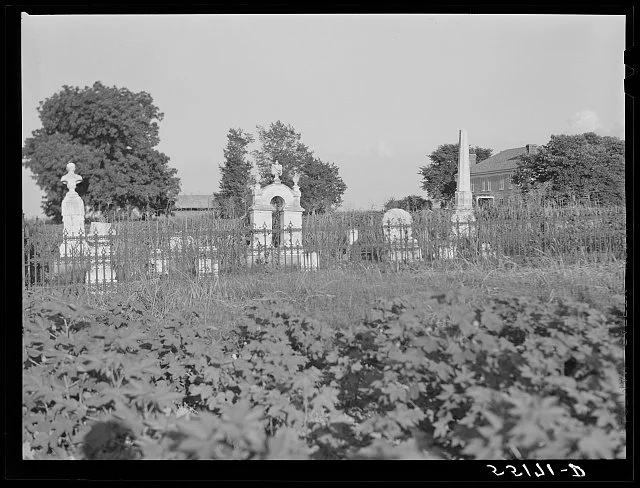
A graveyard in a cotton field on the former King and Anderson Plantation near Clarksdale, Miss. In past times if you passed a graveyard at night, whistling a spiritual or happy song was an act of defiance to keep bad spirits away. Photo from Library of Congress.
But there is yet another deep and abiding element to the spirituals that seems especially appropriate for this time of year.
Despite the best efforts of some revisionist histories in the past few decades, serious political, forensic, and archeological research has consistently shown that American slavery was historically, uniquely horrific. The enslaved people lived short, brutal lives. They existed in a climate of unreasoning violence, murder, rape, and near-starvation. Their existence was defined by the unending cycles of forced, often hellish, labor.
And all of this with virtually no chance at manumission for themselves or their children.
It’s no wonder that when Quakers and other religious groups introduced religion to the enslaved people, they eagerly embraced a faith that offered some, however faint, possibility of a way out. If not in this life, then perhaps in the next.
The spirituals were the sung expression of this new faith.
With the Christian religion came the concept of the devil – Satan, Lucifer, Old Scratch, the Man in Black, the “debbil.”
How do you respond to evil in a world where you are powerless?
You fight back with the only tool left to you – song. And, where possible, a humorous song.
When you secretly laugh at someone, even someone who has the power of life and death over you, you diminish him. It is an act of defiance.
The surviving spirituals show us that to the enslaved people of the Deep South, the abstract Christian concept of Satan paled by comparison to the very real monsters who inhabited their daily lives – their “owners” and overseers. And, in fact, there is compelling evidence that the spirituals often conflated the two. The spiritual may have said “devil,” but it really meant “master.”
Lovell’s exhaustive research has uncovered many spirituals on the topic. In them, Satan is portrayed as a “real person, invisible, untouchable, but real.” He’s a liar, a tempter, and a conjurer, an entity who constantly tries to trick the innocent:
What make Ole Satan follow me so?
Satan hain’t got nothing at all for to do wid me
O Satan told me not to pray,
He want my soul at Judgment Day
Ol’ Satan’s jes like a snake in the grass,
He’s watchin’ for to bit you as-a you pass
But by reducing Satan to human-sized, the enslaved poets made him manageable. By giving him human-like characteristics, they made him less frightening than the omnipresent Satan of some modern Christian faiths who defiantly opposes God even as he uses supernatural forces to overcome true believers. Instead, the Satan of the spirituals can be confronted and resisted:
What make Satan hate me so?
Because he got me once and he let me go
The Devil’s mad and I am glad,
He lost this soul, he thought he had
Brothers, will you pray for me,
And help me to drive old Satan away?
Go ‘way Satan, I don’t mind you
Death gets the same treatment in the spirituals. The enslaved poets lived with death every day. Death is personified as a “robber,” a “creeper,” or as a “thief:”
Death came to my house, he didn’t stay long
Let me tell you, my brother, ‘bout the natchel fact,
Death going to shake this body of mine
But, like Satan, once visualized, Death can be dealt with – and mocked!
O Death, he is a little man
“Death is a little man” like the little monsters, devils, and vampires who come to our door on Halloween. Halloween makes fun of the demons of our most popular horror movies and cuts them down to size – what’s funnier than a 5-year-old in a cheap plastic mask? It helps us laugh at our fears and confront them ... and, in time, confront the root causes of our fears.
Our fears are real. These are difficult times, make no mistake. The world is in turmoil, inflation is eating up our paychecks and savings, individual freedoms are eroding, and mega-oligarchs are bankrolling increasingly autocratic regimes around the world.
Yet, Death is a little man. Satan is a little man. A billionaire is quite literally a little man.
As one of my favorite songs by Ry Cooder (and based on a spiritual) says, “Trouble, you can’t fool me/I see you hiding behind that tree.”
What do little men, little demons fear? What all bullies fear – that you stand up to them, confront them, call them out, vote them out.
Every song, every demonstration, every vote is a protest, a confrontation, an affirmation. As the old gospel song proclaims, “Trouble don’t last always.”
In the end, the spirituals are a call to action:
If you want to see de debbil (or Old Satan) run
Just pull de trigger o’ de gospel gun
In the old days, if work required that you pass a graveyard at night, people would whistle a spiritual or a happy tune. The music – and your defiance – kept the hants, spooks and ghouls away:
Old Satan tremble when he sees
The weakest saint upon their knees
And I won’t stop praying,
That’s what Satan’s a-grumbling about.
This year at Halloween, give Satan – and all of the evils, miseries and troubles bedeviling you – something to a-grumble about!
Note: All lyrics excerpted from John Lovell Jr.’s, “Black Song: The Forge and the Flame: The story of how the Afro-American spiritual was hammered out” (Paragon House Publishers, New York), 1972.
————————————————————————
Robert F. Darden is professor emeritus in Journalism at Baylor University and a member of the Overby Center panel of experts.
