
In the midst of a haunted past, Memphis has sacred, transformative places
By Robert F. Darden
It’s at least an hour into the service at the Rev. Al Green’s Full Gospel Tabernacle, only Brother Al isn’t here. It hasn’t really mattered. The Holy Spirit, the Holy Ghost, the third member of the Christian faith’s Big Three, is here.
Oh, the associate pastor has tried to preach in Green’s absence but on three different occasions during his sermon, the spirit-filled bass player has leapt up and begun an irresistible hypnotic four-note vamp and all heaven has broken loose. The rest of the band, the furiously clapping choir, a couple hundred parishioners and two enthralled white guys are all instantaneously on our feet. In aisles and along the side of the auditorium, beautiful ushers in white gloves twirl in a magical spirit-dance. And I’m completely, utterly, blissfully caught up in it.
Great God a’mighty! It’s good to be back in Memphis.
Like New Orleans, it’s easy to be captured by the many myths of Memphis. It’s not that they’re not true – they are. The best myths always are. But there’s more to Bluff City/Grind City, aka the Home of the Blues, than myth. You don’t have to stray far off the tourist-beaten paths to see the city’s painfully human side.
But it’s that human side that – in my mind – fuels the transcendence of a place, including Memphis.
That’s because sacred spaces abound in this city.
The obvious places to find them are the churches, including Green’s musically powered Full Gospel Tabernacle.
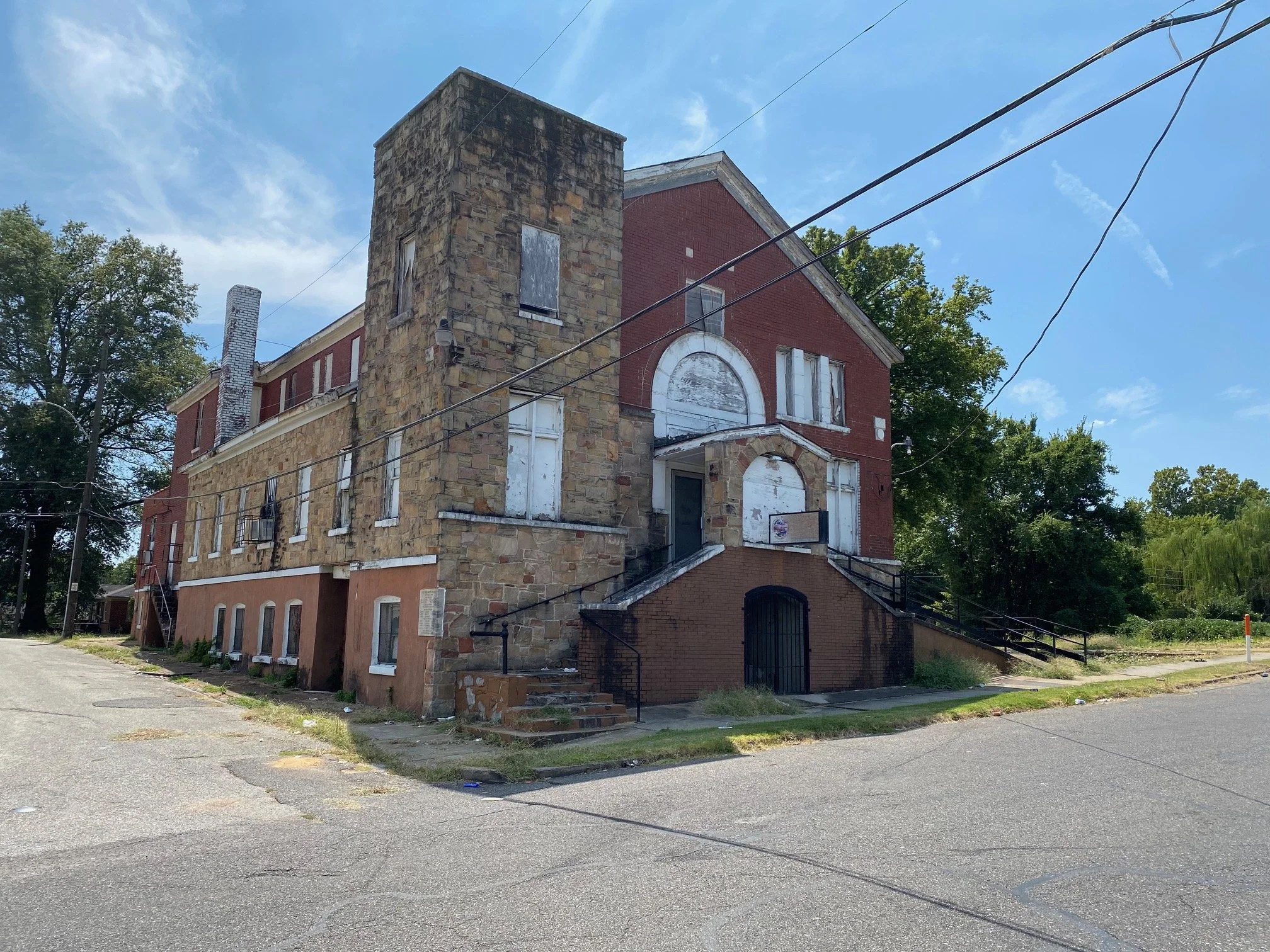
The abandoned East Trigg Baptist Church, home of the brilliant Rev. W. Herbert Brewster. Photo by Robert F. Darden.
We also paid tribute at the first, now sadly abandoned, site of East Trigg Baptist Church, home of the brilliant, influential Rev. W. Herbert Brewster, author of some of the most compelling gospel songs ever recorded – “I’m Leaning and Depending on the Lord,” “How I Got Over,” “Lord, I’ve Tried,” “Let Us All Go Back to the Old Landmark” and gospel music’s first two million-selling singles, “Moving on Up a Little Higher” by Mahalia Jackson and “Surely God is Able” by the Clara Ward Singers. Such was Brewster’s charismatic power that a young Elvis Presley would slip into the back pews during his early years in Memphis.
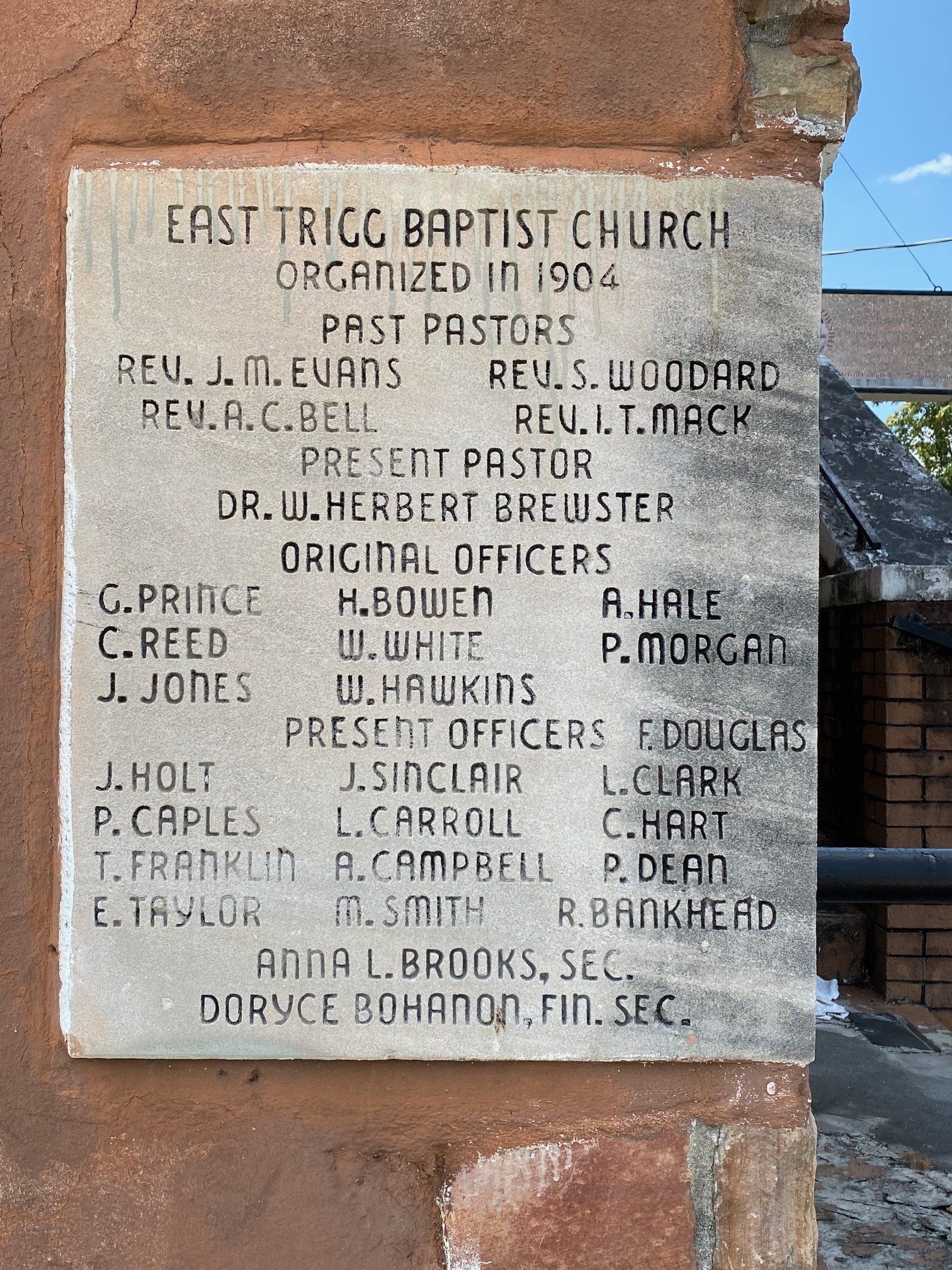
The cornerstone of East Trigg Baptist Church, founded in 1904. A young Elvis Presley would sometimes slip into the back pews of the church during his early years in Memphis. Photo by Robert F. Darden.
We also made a stop at the original headquarters complex of the music-haunted Church of God in Christ (COGIC) denomination. The heart of the facility is the massive Mason Temple, where Dr. Martin Luther King Jr. delivered his prophetic “Mountaintop” sermon, his last, on the evening of April 3, 1968. Certainly, this is a holy place as well.
The allure of Memphis in the 19th and into the 20th century, of course, was heightened by its location as the first stop for hundreds of thousands of Southern Black refugees during the Great Migration. The two most famous routes – via the Illinois Central Railroad and Highway 61 – have justly been heralded in dozens of blues, R&B, rock’n’roll and gospel songs. The Illinois Central was the first “Freedom Train,” taking abused Mississippians north to Chicago via Memphis, though many stayed.
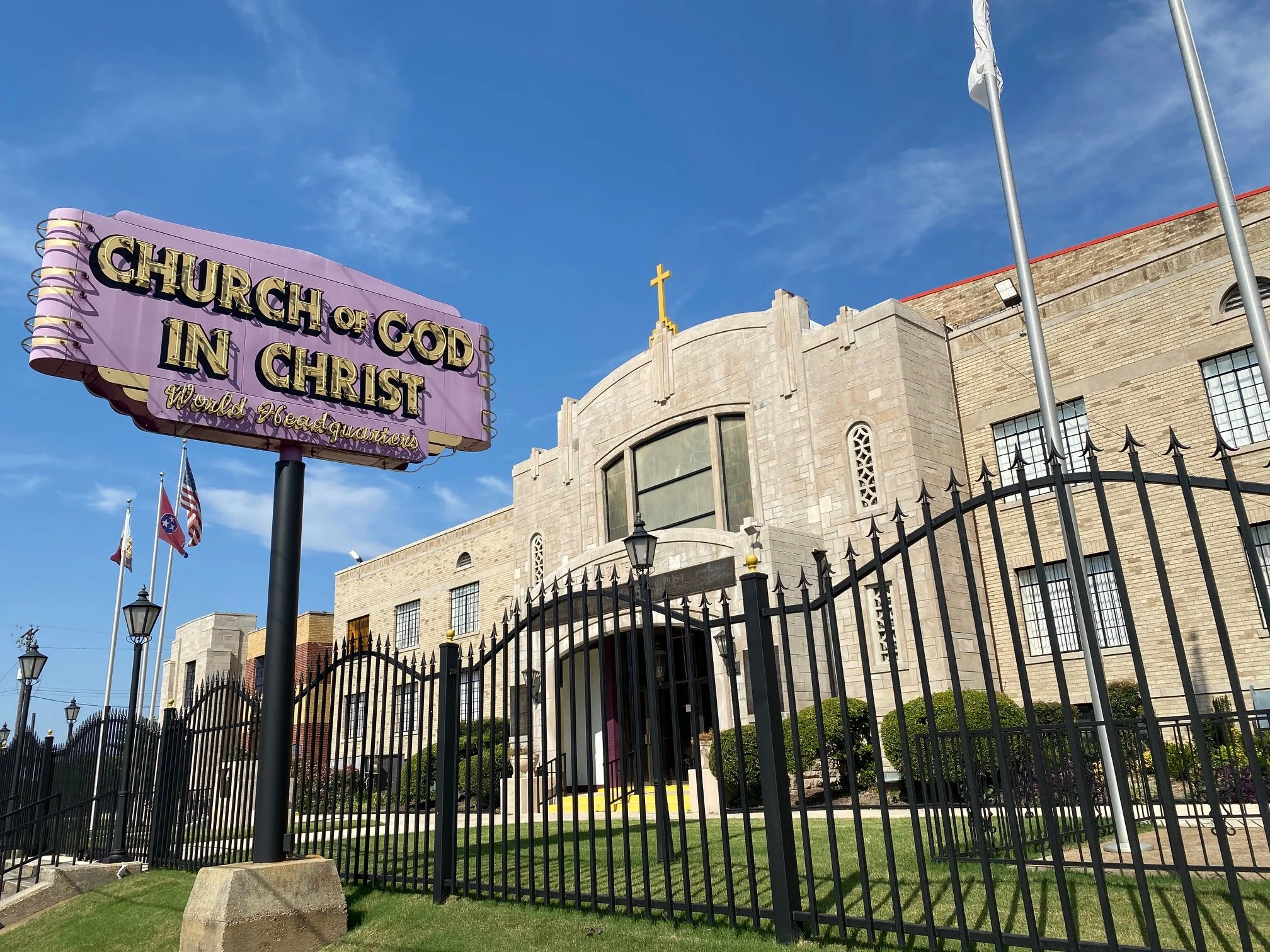
The original headquarters of the Church of God in Christ denomination, where Dr. Martin Luther King delivered his Mountaintop sermon at the Mason Temple on April 3, 1968. Photo by Robert F. Darden.
There are several ways to arrive in Memphis: drive across the massively intimidating Mississippi River from the west on Interstate 40; fly into Memphis International; or journey on Interstate 55 as it thunders up from Mississippi into downtown.
But the best way is to drive up from the South on old Highway 61. Just before sunset, it is easy to imagine you’ve joined the desperate parade of nearly a million African Americans on the Great Migration.
Just being on the justly famous/infamous Highway 61 is a thrill. Where else could one of Bob Dylan’s most chilling lyrics taken place?
Oh God said to Abraham, “Kill me a son”
Abe says, “Man, you must be puttin’ me on”
God say, “No.” Abe say, “What?”
God say, “You can do what you want Abe, but
The next time you see me comin’ you better run”
Well Abe says, “Where do you want this killin’ done?”
God says, “Out on Highway 61”
“Highway 61 Revisited,” from the acclaimed album of the same title, released in 1965.
Dylan’s spare version is great, but give a listen to Beaumont, Texas, native Johnny Winter’s absolutely apocalyptic reading if you dare.
That said, the closer you get to Memphis on Highway 61, the more it looks like the endless big box chain store conformity of any U.S. city. But just south of Memphis, if you detour at Old Commerce Road onto old 61, you’ll find the Hollywood Café in Tunica Resorts, Mississippi, celebrated in Marc Cohn’s “Walking to Memphis,” where Muriel played spirituals every Friday night.
Alas, Muriel Davis Wilkins passed in 1990, but various ghost-hunting TV shows are regular guests at the Hollywood Café because the ghosts are still here.
A place doesn’t have to be religious to be spiritual.
On a previous research visit to Memphis, we spent time in the library at the University of Memphis where, on fragile carbon copies still with the original pencil edits, I read transcriptions of the interviews conducted in the weeks immediately following King’s assassination on April 4, 1968. It’s an interview with musician Ben Branch that most interested me. Branch, a jazz saxophonist and civil rights activist, was musical director for the Southern Christian Leadership Conference’s Operation Breadbasket Orchestra and Choir. It was the day after King’s historic sermon, and another event was planned that evening.
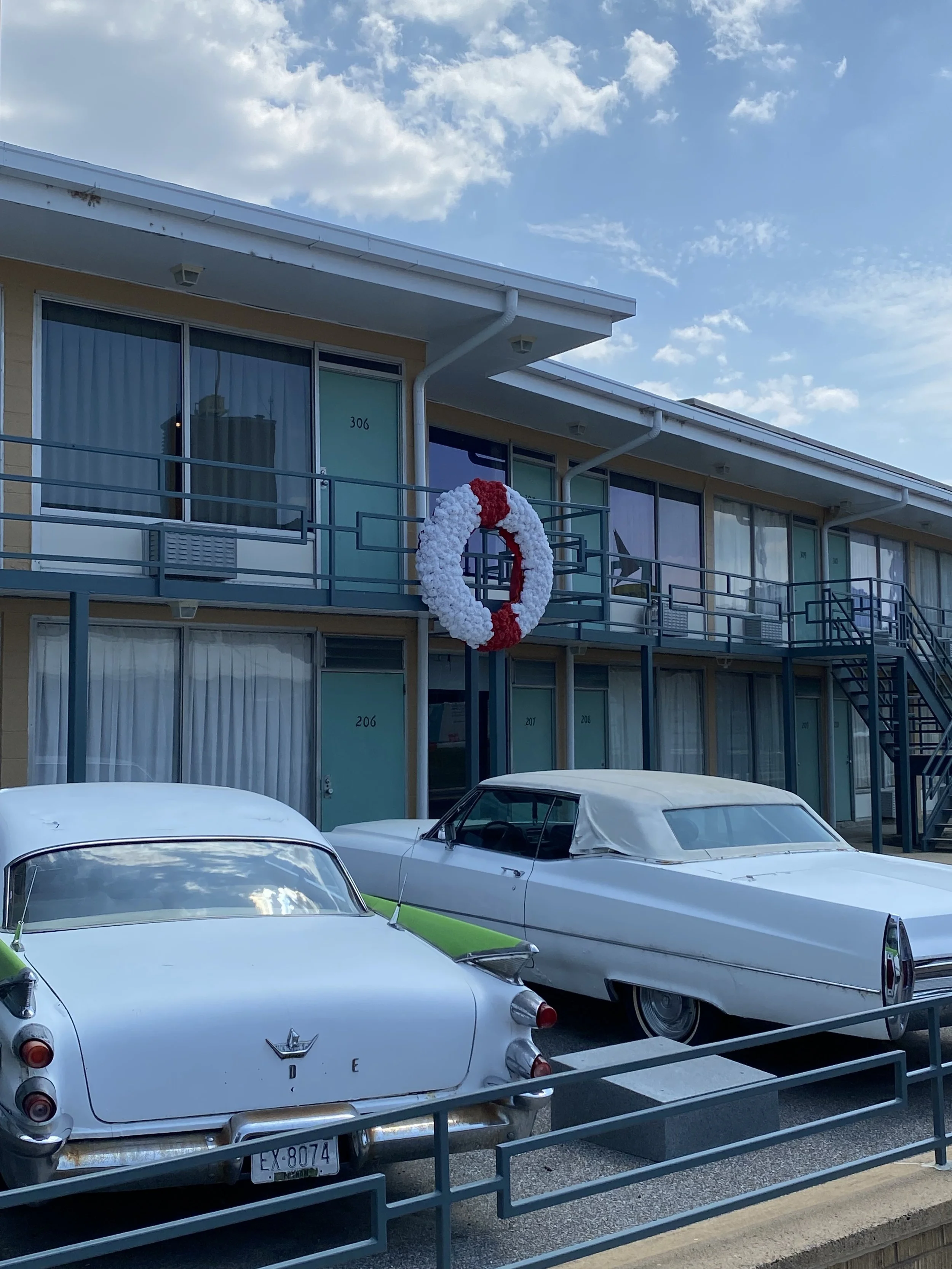
The balcony outside Room 306 at the Lorraine Hotel where Dr. Martin Luther King had his final conversation with musician Ben Branch. Automobiles from the period are in the parking lot as part of the National Civil Rights Museum. Photo by Robert F. Darden.
Branch and his band finished rehearsing in the Lorraine Hotel’s restaurant and walked into the hotel courtyard, then the parking lot where he looked up and saw King, Jesse Jackson, Ralph Abernathy and the others who stood on the balcony outside of Room 306.
King stops Branch and says, “Man, look: I want you to play that ‘Precious Lord’ tonight like you’ve never played it before.”
Branch’s band was scheduled to accompany King later at a Southern Christian Leadership Conference rally.
Branch responds, “Dr. King, I do that all of the time.”
“No, but tonight, especially for me, I want you to play it pretty tonight.”
King pauses, then resumes, “Man, I tell you, tonight I want that song. I mean, I want you to play it pretty tonight, play it pretty.”
Branch, clearly shaken, says, “I’m gonna do that.”
King nods and says, “Don’t forget. I mean, I want ‘Precious Lord.’ Play it tonight.”
Seconds later, King is dead.
His final words were about what is, perhaps, the most beloved gospel song of all, “Take My Hand, Precious Lord,” with its haunting final verse: “When the darkness appears/And the night draws near/And the day is past and gone/At the river I stand/Guide my feet, hold my hand.”
With that still ringing in my ears, a few years later I finally made my long-delayed pilgrimage to the National Civil Rights Museum at the Lorraine Hotel.
After the comprehensive tour, I stood in the parking lot outside the balcony of Room 306, where Ben Branch peered up at the balcony.
I’m still rattled from the intense emotions of the museum, and in that moment I remember the passage in the Old Testament that talks about a place where “stones cry out” from the blood spilled there.
In Branch’s still-raw retelling of Dr. King’s last moments, I hear the stones, too.
As one of the exhibits at the museum reminds us, “You are in a sacred space.”
The past haunts Memphis, as it does so many Southern cities, whose histories are inextricably tied to what Jim Wallis calls America’s “original sin” – the enslavement of human beings.
But in that tortured past, there is also the sacred, the transcendent, the transformative.
You only have to seek it out.
——————————————————————————————-
Robert F. Darden is professor emeritus in Journalism at Baylor University and a member of the Overby Center panel of experts.
