
Charlie Kirk’s death has created new debates on the First Amendment
By Terry Mattingly
Days after Charlie Kirk was assassinated, U.S. Attorney General Pam Bondi poured gasoline on raging national debates about social media chatter celebrating the 31-year-old activist's death.
"Hate speech that crosses the line into threats of violence is NOT protected by the First Amendment. It's a crime," Bondi said. Responding to critics, she added, via social media: "For far too long, we've watched the radical left normalize threats, call for assassinations and cheer on political violence. That era is over."
Prominent conservatives immediately rejected her words, noting that "hate speech" is a term, historically, used by the hard left.
Some of the statements opposing Bondi included this relevant point of view: "You should be allowed to say outrageous things. … There's ugly speech. There's gross speech. There's evil speech. And all of it is protected by the First Amendment."
That quote was from Charlie Kirk.
Sen. Ted Cruz of Texas noted that, while some employees may face "consequences for celebrating murder" in the workplace, any talk of government actions is out of line. "The First Amendment absolutely protects speech," he said, at a Politico tech summit. "It absolutely protects hate speech. It protects vile speech. It protects horrible speech. What does that mean? It means you cannot be prosecuted for speech, even if it is evil and bigoted and wrong."
Weeks later, red and blue America is still debating the cause of Kirk's murder. Did this conservative activist, to some degree, reap what he sowed in years of blunt, candid speech on gender, immigration, Great Society programs, DEI and other topics? Or was he a First Amendment martyr killed – according to the accused shooter's family and emerging Internet evidence – by a dark-Web Antifa disciple with personal ties to a transgender network?
In a related firestorm, late-night commentator Jimmy Kimmel was, briefly, taken off the air for sharing this progressive talking point: "The MAGA Gang (is) desperately trying to characterize this kid who murdered Charlie Kirk as anything other than one of them and doing everything they can to score political points from it."
A big question loomed in the background: Have millions of Americans decided that it's acceptable to use violence to silence speech they consider offensive or even "violent"?
Consider this headline from an updated report from the First Amendment defenders at FIRE (Foundation for Individual Rights and Expression): "Student acceptance of violence in response to speech hits a record high – Over the past five years, it's gone up almost 80%."
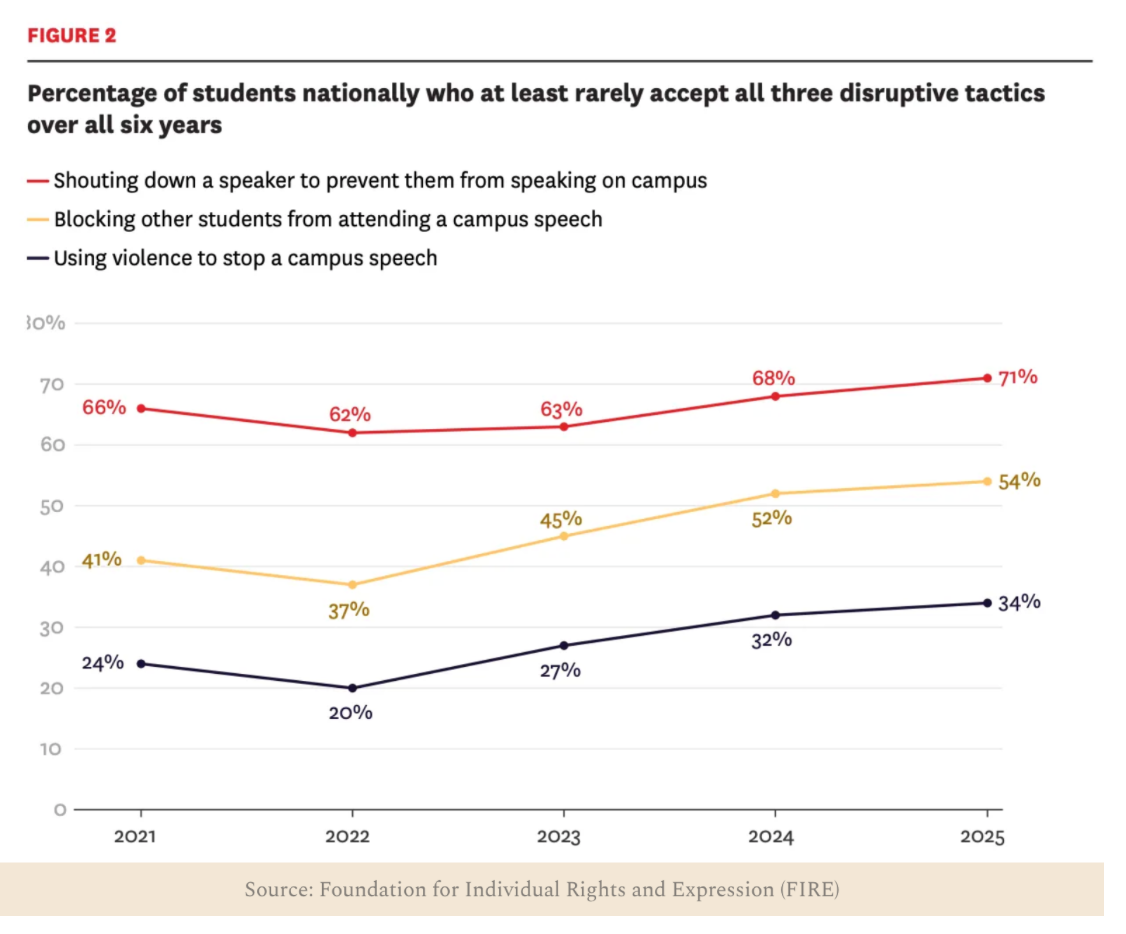
This graphic shows the increase in student acceptance of violence in response to speech. Graphic courtesy of the Foundation for Individual Rights and Expression, www.thefire.org.
That feature by Ryne Weiss and Chapin Lenthall-Cleary noted: "According to FIRE's annual College Free Speech Rankings survey, in 2020, the national average showed about 1 in 5 students said it was ever acceptable to use violence to stop a speaker. That number has since risen to a disturbing 1 in 3 students. … (T)here's no doubt that the 50% increase in this level of support for political violence among college students over the last 5 years has broad implications for the future of the country."
What about the "heckler's veto," as in the "mild" option of shouting down a speaker? The survey showed that 71% of students now back that option. What about physically blocking students from being able to safely attend a lecture on their own free will? These days, 54% of students support that blunt approach to opposing free speech, freedom of religion and freedom of assembly.
Finally, what about violence? Updated national FIRE research indicated that the percentage of students supporting "violence to stop a campus speech" has risen from 24% to 34% in 2025.
The FIRE report added: "Those students who are the furthest to the left have been the most accepting of violence for as long as we've asked the question. That includes very liberal and democratic socialist students. But a rising tide of acceptance of violence has raised all boats. Now, regardless of party or ideology, students across the board are more open to violence as a way to shut down a speaker."
There is more to this drama than a simplistic left vs. right clash. Some of the most revealing commentary came from old-school First Amendment liberals who praised Kirk's commitment to debates on college and campuses – even the Oxford Union Society – in which he handed critics the microphone and took questions.
Comedian Bill Maher welcomed Kirk to his Club Random podcast for a friendly conversation that aired earlier this year on Easter. Maher was shaken by Kirk's bloody death and, on his "Real Time" show, the religious agnostic and political liberal said: "I like everybody. … But he was shot under a banner that said, 'Prove me wrong,' because he was a debater, and too many people think that the way to do that – to prove you wrong – is to just eliminate you from talking altogether. So, the people who mocked his death or justified it, I think you're gross. I have no use for you."
Podcast superstar Joe Rogan was hosting actor Charlie Sheen when the Kirk news broke. Both were stunned, and in a flurry of live F-bombs, Rogan cut to the chase: "He was not a violent guy. He was talking – talking to people on college campuses. Wasn't even particularly rude. … Whether you agree with him or not, and there was a lot of stuff I didn't agree with him on, you're allowed to disagree with people without celebrating the fact they got shot."
Shaking his head sadly, Sheen said: "Murdered for having a different opinion from somebody else, different ideology from somebody else. Rest in peace. … He doesn't deserve that. Nobody deserves that."
___________________________________________
Terry Mattingly is Senior Fellow on Communications and Culture at Saint Constantine College in Houston and a member of the Overby Center panel of experts. He lives in Elizabethton, Tenn., and writes the national On Religion column for the Andrews McMeel Universal syndicate.