
Speculation about U.S. Rep. Henry Cuellar’s future as a Dem is in the mix with indictments
By Carlos Sanchez
Even before the Texas Legislature finished shoving into law this summer a rare mid-decade redistricting map at the behest of President Donald Trump prompting a national debate over Republican overreach, the favorite political parlor game had begun: Who was going to run for what congressional seat? Who was going to drop out? And who was likely to lose his or her seat because of the gerrymandering aimed at increasing Texas’s GOP strength in the U.S. House of Representatives by as many as five seats.
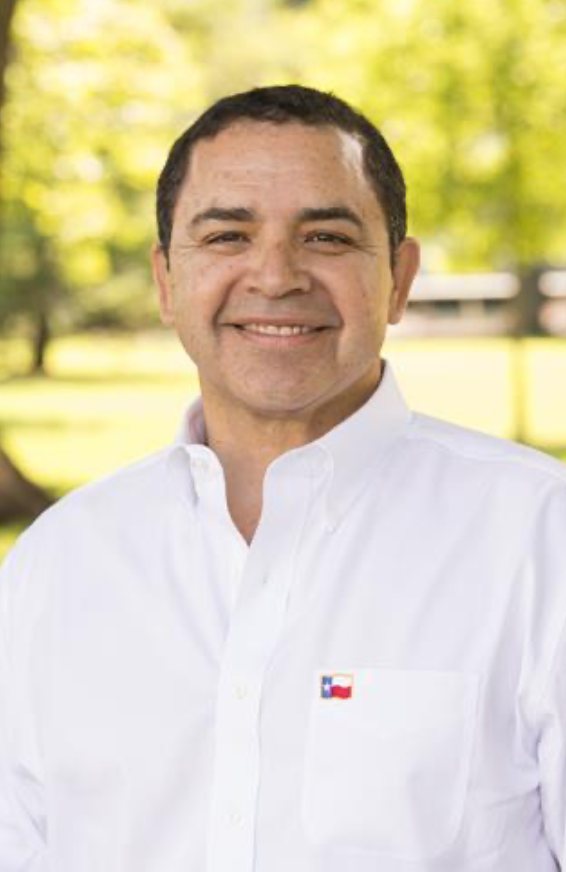
U.S. Rep. Henry Cuellar of Texas. House.gov photo.
And because this cascade of events was initiated by Trump, it involves a new element of political intrigue that might be aptly named the Eric Adams effect. It’s a growing theory among some Texas Republicans that it may not be necessary to win all five pickup seats in next fall’s election. That’s because perhaps the state’s most effective Democratic congressman may be cutting a deal to switch parties for political survival — and to avoid prison for himself and his wife.
Veteran 11-term U.S. Rep. Henry Cuellar of the 28th Congressional District, and his wife, Imelda Rios Cuellar, are currently facing a 12-count indictment on federal charges of bribery, fraud and money laundering stemming from allegations that they received $600,000 from agents representing Mexico and Azerbaijan. The couple face a maximum prison sentence of 180 years.
The speculation is that Cuellar, arguably the most conservative Democrat in Congress who represents a district surrounding the border community of Laredo, Texas, could easily make the transition to the GOP and, in return, have the federal charges against him dropped.
Cuellar has said that he is innocent of the charges and even sought an opinion from the House Ethics Committee before acting on some of the counts that federal prosecutors would later say violated federal law.
A version of this played out earlier this year with Democratic New York Mayor Eric Adams, who was also facing federal bribery and fraud charges as well charges of soliciting foreign campaign donations. And while Adams did not switch parties, he left the Democratic Party after coming out in support of Trump’s immigration initiative.
The move initiated by Trump was logical given Adams’ public criticism of the Biden administration immigration policies and the mayor’s claims that he was being criminally targeted by the Biden administration because of those criticisms. In February, the Trump Justice Department dropped all charges against Adams. He initially sought to win re-election as mayor of New York as an independent. Adams has now suspended his lackluster campaign, suffering from fallout by a heavily Democratic city by what was viewed as a deal with the Trumpian devil. His name will remain on the ballot, but it is all but a certainty that he will not be re-elected.
In the case of Cuellar, there is more logic and history fueling the speculation that he could switch from an embattled Democrat seeking re-election and facing criminal charges to a viable Republican candidate fresh from having all criminal charges against him and his wife dismissed.
Cuellar is one of the most educated members of Congress, earning eight separate post-secondary degrees in his career, including a Ph.D. and a law degree. He is the eldest of eight children of migrant farmworkers living in the South Texas town of Laredo and the first in his family to earn a college degree.
But he wasn’t the only high-achieving Cuellar. His brother is sheriff of Webb County, where Laredo is located, and his sister was the former tax assessor/collector of Webb County and also a municipal judge in two small Webb County towns. She ran for the Texas Legislature last year but was defeated in the Democratic primary. Still, the Cuellars remain one of the most prominent political families in South Texas.
Part of Congressman Cuellar’s political success is his willingness to work with – and in one case for – Republicans. While his ability to reach across the partisan aisle has made him a potent political force among an often-impotent Democratic congressional delegation from Texas, it has also raised suspicions and even the ire of his own political party.
“I’m a Democrat, but I don’t put party before country,” Cuellar said during a press availability on the eve of the federal government shutdown. “I go and I represent my district. And I think you all know me and sometimes I vote with Democrats. Sometimes I don’t vote with Democrats. I vote my district. I put country before party.”
Cuellar was elected to the Texas Legislature in 1987 and stunned political observers in 2001 when Republican Governor Rick Perry appointed him to be Texas Secretary of State. Although he only served in that role for nine months, Cuellar’s service to a Republican governor raised suspicions about his loyalty to the Democratic Party.
Cuellar is considered a moderate Democrat, but he is also unapologetically conservative on many social issues. In 2022, before Roe v. Wade was overturned by the U.S. Supreme Court, Cuellar became the only Democrat in Congress to vote against a bill that expanded access to abortion.
And he became a pariah to more progressive Democrats, twice drawing a primary opponent endorsed by the likes of Rep. Alexandria Ocasio-Cortez of New York, as well as Sens. Bernie Sanders of Vermont and Elizabeth Warren of Massachusetts.
At the same time, Cuellar held a leadership position on the House Appropriations Committee, which allowed him to effectively fight against a major first-term Trump initiative to build a border wall. Cuellar helped pass legislation prohibiting such construction that might impinge on several birding sanctuaries and historic cemeteries. He was forced to relinquish the leadership position when he was indicted.
His actions helped draw the backing of former House Speaker Nancy Pelosi who endorsed him during his primary battles.
Cuellar showed his political strength first in 2022, the year the FBI raided his home and office in what was a harbinger for legal problems. Despite the bad publicity from that raid, he beat his Republican rival, Cassy Garcia, that year by a margin of nearly 13.5 percentage points.
His next election in 2024 was plagued by news of his federal indictment, yet he still prevailed over Republican challenger Jay Furman by a slimmer margin of 5.6 percentage points. But the bigger news that year was Trump sweeping 14 of 18 heavily Hispanic and traditionally Democratic border counties, including Cuellar’s. It diminished long-held hopes that Hispanics are the key to Democrats regaining power in deep red Texas.
But Republicans in Congress still hold a razor thin margin of five delegates, prompting Trump to seek the mid-decade redistricting plan to pump up the GOP delegate count.
And while the Texas Legislature redrew the South Texas districts hoping to secure three House seats for Republicans, Cuellar’s electability cannot be dismissed. Speculation about his future in the Democratic Party was bolstered after two former campaign staffers and a third foreign national all pleaded guilty last year to conspiracy charges in the case against Cuellar.
Speculation grew in August, when federal prosecutors dropped two of the original 14 charges against Cuellar and his wife after Republican Attorney General Pam Bondi issued a memo narrowing the enforcement of laws relating to foreign lobbying and bribery.
When a U.S. district judge in Houston threw out the two charges, he also delayed a trial date until next April — after next year’s scheduled primary
___________________________________________
Carlos Sanchez is a freelance writer based in McAllen, Texas. He is a member of the Overby Center panel of experts.