
The protest spirituals became hallmarks of free speech and civil rights
Editor’s note: The Overby Center for Southern Journalism and Politics will present “Free Speech, Freedom Songs and the Music of Liberation” on Feb. 25, 2026. The event will be at the Overby Center on the University of Mississippi campus as a part of Black History Month. Robert F. Darden, emeritus professor at Baylor University, will speak on the history and development of some of the most important Freedom Songs. A Black gospel group will perform. More details will be announced soon on the Overby Center website.
By Robert F. Darden
When your freedom of speech is denied you, what can you do?
You can sing!
The spirituals of enslaved African Americans from the 18th and 19th centuries remain with us today, potent, melodic remainders of a day the force of law stripped an entire population of its freedom and all rights, including expression. But a host of unnamed and unknown poets took the one art that remained to them – song – and transformed it into a powerful mode of communication and protest.
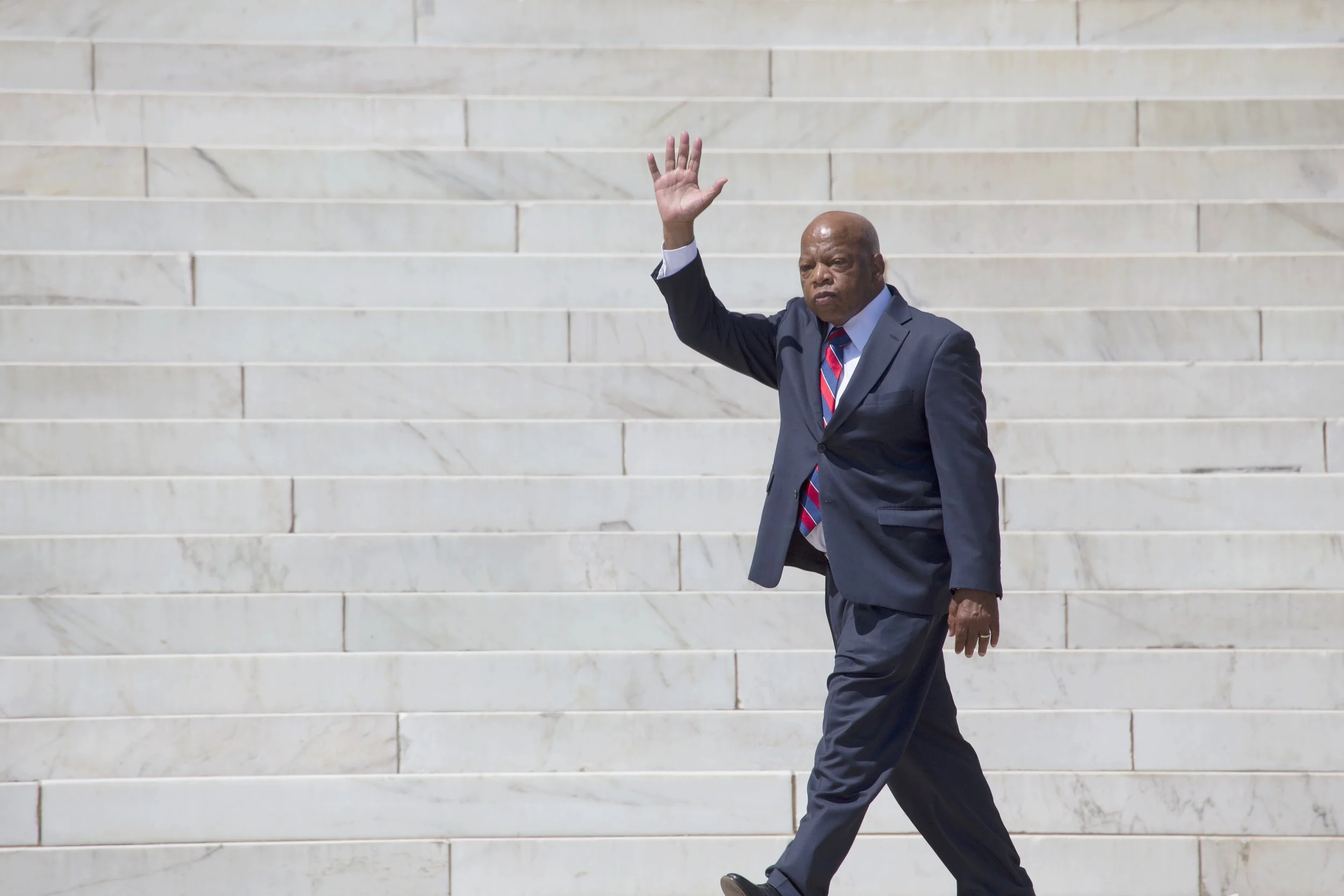
The late Rep. John Lewis said, “"Without music, the Civil Rights Movement would have been like a bird without wings." Photo from Shutterstock.
Thanks to the research of Dr. Henry Louis Gates Jr. and others, we now know that many (if not most) spirituals had what Gates called a “double-voicedness.” There was one message for the cruel overseers of the plantations and quite another for those who worked the fields and factories.
A better description of this ancient art, which has its roots in Africa, would be “protest spiritual.” The very act of singing these songs was a protest.
We know that from the writings of the heroic Harriet Tubman that “Go Down, Moses,” “Swing Low, Sweet Chariot,” “Steal Away” and others actually contained coded messages: “Go Down, Moses” says, “let my people go!” The “chariot” is the Underground Railroad. And “steal away to Jesus” could hardly be misconstrued.
Others, such as “If the Lord Could Deliver Daniel, Why Not Any Man,” are so obvious that you have wonder at the intelligence of the brutal “pater-rollers” who stood outside the cotton fields with their guns and heard these clearly defiant words.
If you don’t have freedom of speech, you make your own freedom.
So it makes sense that with the advent of the modern Civil Rights Movement in the late 1950s, the freedom fighters in the marches and in the churches would adopt many of the protest spirituals as their own – and transform them into Freedom Songs: “Up Above My Head, I See Freedom in the Air,” “O Freedom,” “Amen,” “Ain’t Gonna Let Nobody Turn Me ‘Round,” “(Keep Your Hands on the Gospel Plow and) Hold On” and many, many others besides.
Like the protest spirituals, the Freedom Songs were wonderfully adaptable. Entire verses could and would be spontaneously re-written to address specific towns, individuals, and issues. Most were never sung the same way twice as they traveled the Civil Rights trail, from the sit-ins to the Freedom Riders, from Albany to Montgomery to Birmingham to Mississippi to Selma and beyond.
And like the spirituals, the Freedom Songs conveyed essential information beyond the protest – what was happening in other Civil Rights sites, who to avoid, who to embrace, how to carry on. When you don’t have access to the press, much less television, radio or magazines, you find other means to express yourself.
There are other sources to the great Freedom Songs, of course. Both “We Shall Not Be Moved” and “Which Side are You On?” are adapted from old union songs. “This Little Light of Mine” was originally a children’s Sunday School song.
And then, there is the most famous, most powerful Freedom Song of all, “We Shall Overcome.” It combines the old Baptist hymn "I'll Be Alright" and C.A. Tindley's "I'll Overcome Someday” and adds its own unique phrasings. Zilphia Horton of the Highlander Folk School of Tennessee said she first heard it from striking North Carolina tobacco workers in the 1940s. Beloved folk singer Pete Seeger changed the title to "We Shall Overcome" and with Guy and Candie Carawan taught it to each new generation of Highlander attendees. Among those who first heard “We Shall Overcome” at Highlander were Rosa Parks, John Lewis and Martin Luther King Jr. It quickly became the anthem of the Civil Rights Movement. It is still sung today.
That’s the thing about the protest spirituals and Freedom Songs – they embody the heartfelt desire of every human being to be heard.
They were sung at Tiananmen Square in China, during the Arab Spring, on Wall Street and in Hong Kong, Ferguson (MO.), Baltimore, Chicago, and Staten Island, during the #blacklivesmatter demonstrations and during the #metoo marches. They’re still being sung today at a time when voter suppression, assaults on the press, and an all-out war has been declared on the rights guaranteed by Constitution.
Why? Because they work. They inspire, they unify, they give comfort and courage, they give solace.
In an interview, the late Rep. John Lewis once told me, "Without music, the Civil Rights Movement would have been like a bird without wings."
Freedom of speech is a rare and delicate gift, one that must continually be guarded from tyrants and ideologues and misguided religious leaders and simple bullies. Freedom to speak, to sing, to write, to express yourself in any way is as precious as clean air.
Practice it. Celebrate it. Fight for it.
Sing it.
—————————————————————————————————-
Robert F. Darden is emeritus professor of Journalism, Public Relations & New Media at Baylor University.
