
By Terry Mattingly
The first thing I heard when I punched the flashing button on my newsroom telephone was the background noise of airplanes and flight announcements.
This anonymous caller in 1983 was on a payphone in a major airport. He called the switchboard in the building that housed The Charlotte Observer and asked for the religion writer. Since the city's famous morning newspaper didn't have a religion-beat reporter at that time, the operator transferred the call to me at The Charlotte News, the much smaller afternoon paper.
This man with a strong Southern accent declined to give his name, citing "safety" issues. He had insider information he wanted to share about the Rev. Jim Bakker, leader of the PTL Club ministry and cable-television network just over the South Carolina border below Charlotte. I started taking notes.
"My name is synonymous with religion. I don't think there is a household in America that wouldn't know my name. I've got to talk to somebody, somehow, someday. I'm scared to death. It's a moral thing to me," he said, in quotations from my notes in Charles Shepard's book, "Forgiven: The Rise and Fall of Jim Bakker and the PTL Ministry," published in 1989.
The Observer's great investigative reporter had photocopies of my notes because I gave them to him when I left Charlotte, in part because – after the merger of the two newsrooms – I couldn't convince editors to let me probe my caller's accusations. I also believed that, in addition to a financial scandal, Bakker's giant flock of viewers and donors symbolized a major change in American religion, with nondenominational, independent and "charismatic" churches pulling believers out of "mainline" pews.
Shepard, in years of reporting that led to a Pulitzer Prize, confirmed that my anonymous caller was the Rev. John Wesley Fletcher – a Bakker colleague who had been cut loose by PTL and the Assemblies of God. Fletcher shared some private telephone numbers and other "insider" PTL information, insisting that Bakker assistants James and David Taggart were the powers behind the throne and that David was, in fact, the broadcaster's "lover."
"I never knew a more corrupt man in my life, period, than Jim Bakker," Fletcher told me. "Now I see him for what he was." He called two more times, seeking an interview a safe distance from Charlotte. Alas, the religion beat didn't have a travel budget.
Fletcher signed off with this: "Just remember this name – Jessica Hahn." He didn't describe his role in arranging Bakker's tryst with the young church secretary. And Fletcher didn't mention a claim he made later, saying that he, too, had been sexually involved with Jim Bakker.
When he resigned at PTL, Bakker vaguely noted: "I sorrowfully acknowledge that seven years ago ... I was wickedly manipulated by treacherous former friends and colleagues who victimized me with the aid of a female confederate. They conspired to betray me into a sexual encounter at a time of great stress in my marital life. I was set up as part of a scheme to co-opt me and obtain some advantage for themselves over me in connection with their hope for position in the ministry."
If anything, the tawdry accusations against Bakker slowed coverage of the scandal. I am convinced that editors, in Charlotte and elsewhere, were more comfortable chasing details of the PTL leader's financial sins than dirt about his personal life. The same was true in coverage after Bakker's death, at age 86, on October 5.
Money and "televangelist" politics were more interesting than religion news. But The New York Times obituary on Bakker included a stunning detail that pointed to a larger, more mysterious story. It noted: "The Bakkers drew as many as 13 million viewers a day and brought in yearly revenue as high as $129 million."
The sale of bad securities sent Bakker to prison in 1989, and the $250,000 PTL check to buy Hahn's silence didn't help, either. But note the size of Bakker's audience, during his peak cable-television years – 13 million viewers a day.
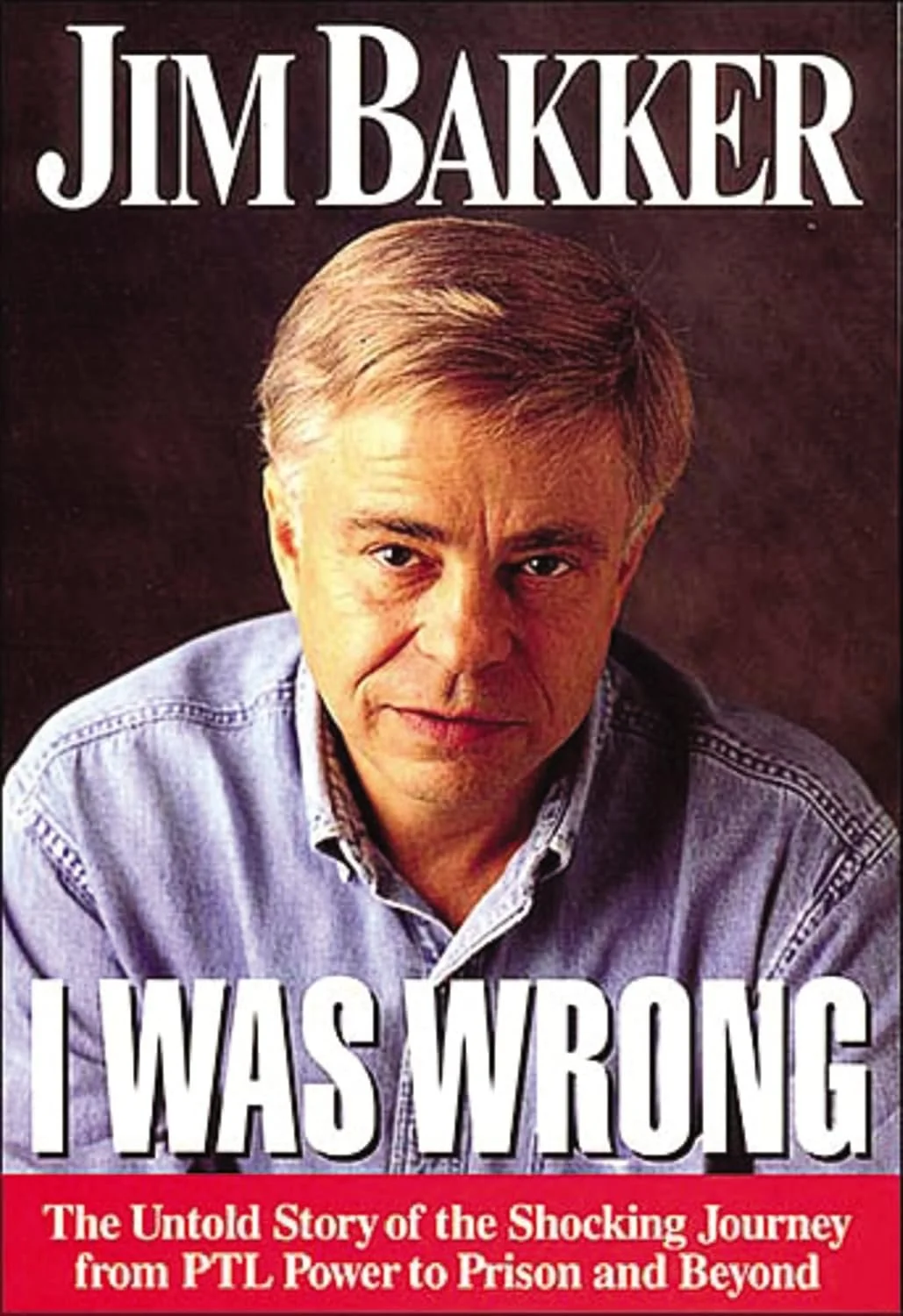
After his fall from grace and time in prison, Jim Bakker wrote of the events in a book published in 1997.
Using search engines and the Grok AI platform, I learned that Bakker's audience was about the same size as Oprah Winfrey’s flock in the early 1990s. That number is four or five times larger than similar shows today. "The Five" on Fox News has 3.15 million viewers. CNN's primetime average is about 608,000. "Jimmy Kimmel Live!" has about 2.5 million viewers.
Yes, Bakker was in another era, when the cable marketplace was not as complex and YouTube was not luring millions of viewers away from networks big and small. The Grok summary concluded: "So, 13 million is not 'a strong cable talk show.' It is several times the entire primetime audience of the most-watched cable news network, and well above any regular series currently on cable."
Bakker was not a fringe "televangelist." He was a TV star, period, who wanted a desk and a microphone like his hero, Johnny Carson. Bakker showed little interest in ministry or evangelism. Leaders of his own denomination, the Assemblies of God, considered him a loose cannon, even a heretic, as he veered into what many called a "prosperity gospel."
But the size of his TV audience pointed to this truth – he was reaching believers all over America, not just in rural ZIP codes and trailer parks. In Charlotte, I sent memos to my editors noting that many of his donors were fleeing liberal mainline churches, seeking a shepherd they believed was blending old values with TV charm.
This was a major news story. Bakker didn't attract 13 million viewers with sermons, Bible lessons, hymns and altar calls. In their "charismatic" soap opera, Jim and Tammy wept, laughed, sang, and shouted their way into the hearts of millions of viewers in New South suburbs and other parts of America.
Today, the "Seven Sisters" of "mainline" Protestantism – American Baptists, Disciples of Christ, the Evangelical Lutheran Church, the Presbyterian Church (USA), the Episcopal Church, the United Church of Christ and the United Methodist Church – are about 8.7% of the U.S. population. That number was 52% in the 1960s.
One of America's best-known authorities on religion trends, political scientist Ryan Burge of the John C. Danforth Center at Washington University in St. Louis, estimates that nondenominational Christians have grown from 3% of all Americans in 1972 to nearly 14% today. That's 40-45 million Americans, a hard-to-describe flock that is larger than all mainline Protestant churches combined, with the Southern Baptist Convention tossed in there as well.
"Non-denominational churches are the biggest winners in American religion over the past few decades," Burge tweeted on X this summer. "But only 31% of non-denoms today were actually raised non-denom. The other 69%? They came from everywhere."
Where did Bakker's PTL believers come from? They came from everywhere.
That was a major religion-news story that few noted at the time and, truth be told, the growth of nondenominational, "Bapticostal" faith is still a mystery to many.
Veteran journalist Louis Moore, former religion editor of the Houston Chronicle, covered it all in the 1970s and '80s and, at one point, served as president of what is now the Religion News Association. In 1982, a promotional tour for a book written with his wife Kay led to an appearance on the PTL Club.
"That was a time when there was so much ferment in churches. There was distrust building up in old labels and denominations," said Moore, soon after Bakker's death. "People were on the move, headed into the whole amorphous, Bible-church, independent kind of thing that was springing up. Jim Bakker rode that wave. That was when everything started changing."
——————————————————————
Terry Mattingly writes the national "On Religion" column for the Andrews McMeel Universal syndicate and "Rational Sheep," a Substack newsletter on faith and mass media. He is a member of the Overby Center panel of experts.