
Significant membership declines continue in mainline faith denominations
Editor’s note: This is one in a series of essays by the Overby Center for Southern Journalism and Politics marking the 250th anniversary of the founding of the United States of America.
By Terry Mattingly

As the first female to lead the Episcopal Church, Presiding Bishop Katherine Jefferts Schori was an obvious choice for a New York Times "State of the Church" feature in 2006.
One question was obvious: The New York City-based denomination's membership peaked in the 1960s at 3.4 million, then headed into free fall. When asked if she was an "unrepentant liberal," especially on LGBTQ+ issues, Schori replied: "We're not about being either left or right."
Asked for a membership update, she said: "About 2.2 million. It used to be larger percentagewise, but Episcopalians tend to be better-educated and tend to reproduce at lower rates than some other denominations. Roman Catholics and Mormons both have theological reasons for producing lots of children. We encourage people to pay attention to the stewardship of the earth and not use more than their portion."
Thus, the denomination that has produced 11 American presidents is shrinking because its members are more educated than folks in fertility-friendly pews, but this is a virtue because green theology helps the environment.
Episcopal leaders hesitate to state current membership totals because of changes in parish surveys, but the numbers have already reached 1.5 million, or thereabouts. Some demographers predict institutional demise by 2050, which is better than the Anglican Church of Canada, which could vanish by 2040.
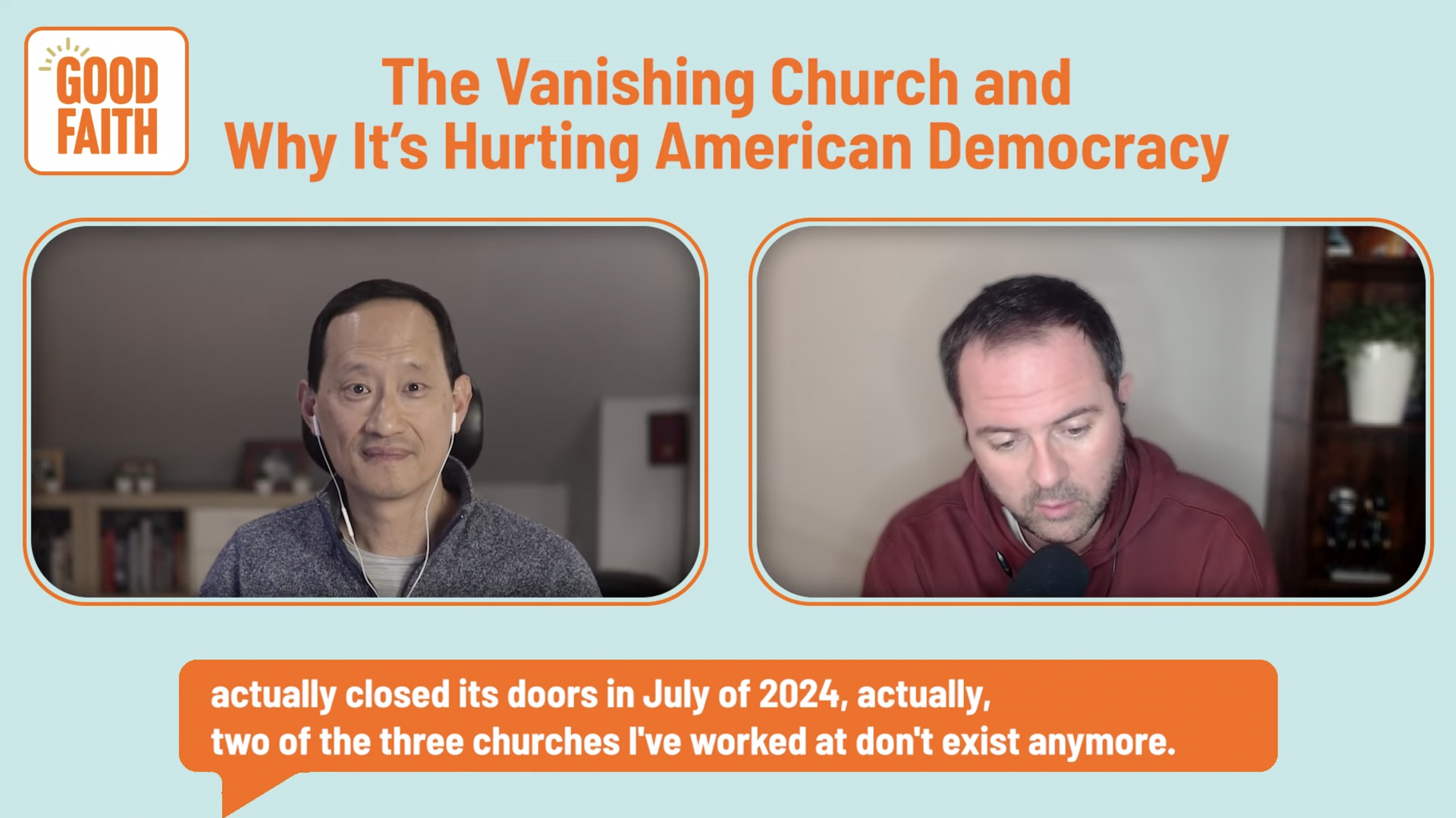
Press the play button for an in-depth interview with Ryan Burge, author of “The Vanishing Church.”
Episcopalians are not alone. The ever-quotable political scientist Ryan Burge put this blunt headline on an early-2026 Graphs about Religion post: "When are Half of Your Members Going to be Dead?"
"Episcopalians are old," he wrote. "Two-thirds of their adult members have celebrated their 60th birthday. Just 6% are under the age of 30. Put simply: for every young adult Episcopalian in the pews this Sunday, there will be about 10 retirees. Oof."
Episcopalians hold five funerals for every wedding, he said, in a January 23 address for the Episcopal Diocese of Central Florida. "My job is to tell the truth," said Burge, who teaches at Washington University in St. Louis. For Episcopalians, "The check engine light is flashing."
For citizens concerned about the American public square, these red numbers are more than symbolic. For decades, historians have noted the civic power of the "Seven Sisters" of "mainline" Protestantism – the American Baptists, the Disciples of Christ, the Evangelical Lutheran Church, the Presbyterian Church (USA), the Episcopal Church, the United Church of Christ and the United Methodist Church.
As the 1960s dawned, these churches represented 52% of the U.S. population. That fell to 30% in 1970 and has now hit 8.7%.
Looking at PCUSA numbers, Burge recently noted that this flock is projected to have 500,000 members in 2040, down from 3.1 million 50 years earlier. With this trend line, he has projected this mainline flock will hit zero sometime before 2050. One or two "Seven Sisters" are shrinking faster.
That would have seemed impossible on March 8, 1948, when Time magazine editors put theologian Reinhold Niebuhr of the prestigious Union Theological Seminary on the cover while celebrating the magazine's 25th anniversary. Only six years after that salute to the mainline, Time turned its gaze South, focusing on the Rev. Billy Graham, a young Southern Baptist evangelist.
Times were changing. Bible Belt faith returned to the spotlight in 1976, with President Jimmy Carter of Georgia, a "moderate," rather mainline Protestant, Southern Baptist. Journalists offered a hurricane of ink about this strange, mysterious 40% of the body politic called "evangelicals."
Today, evangelical statistics remain high and, in some cases, the numbers are rising. Southern Baptist numbers have fallen slowly, in large part because millions of members have jumped to America's fastest growing flock – nondenominational Protestantism, which many researchers call "Bapticostal." That's Baptist polity and Pentecostal style.
The question, according to Burge, is how this power shift has warped public life. As a mainline-style Baptist, he is not amused. In his book, "The Vanishing Church," Burge did share this painful truth – mainline decline, mixed with brash secularism, has been a disaster for Democrats.
"As early as 2005, the share of liberals who were nonreligious was 30 percent. It exceeded 40 percent by the mid-2010s," he wrote. In a 2022 survey "about 46 percent of the liberals were nonreligious," with numbers higher among white liberals. "In the mid-1970s, the gap between the far left and far right sides of the American electorate on matters of faith (also called the God gap) was 13 points. Today it is 34 points."
Burge believes mainliners, with their retreat, created a gap in American life through which conservative believers happily marched. The collapse of the old mainline has made it harder for citizens to move to the center and build consensus.
In an essay for The Free Press, Burge denied that mainliners are "liberal" or "woke." He noted, "The image many people have of the mainline tradition is that it's full of rainbow flag-waving, NPR-listening political progressives. That's not true. While the leadership in many of the most prominent denominations is progressive, there's been no period in the last 50 years when the mainline had more Democrats than Republicans. Instead, the phrase that best characterizes the mainline tradition is 'middle of the road.' These are churches where people with different political beliefs sit side by side."
This "declension story" offers obvious winners and losers, with mainline heroes and Bible Belt villains, noted Abilene Christian University theologian Brad East in First Things, an interfaith journal focused on religion, theology and philosophy. The problem is that this fails to explain why the "Seven Sisters" collapsed in the first place.
Burge insists that mainline churches were "a place to feel welcomed and embraced no matter how much or how little one believed in Jesus Christ that particular Sunday – or how one cast their ballot on Election Day."
In this simplistic drama, said East, "Zealotry was uncommon; doubt was welcome." Jumping over decades of demographic change, "These trends culminated in the two presidencies of Donald Trump, who consolidated the white evangelical vote, capitalized on a polarized electorate, and exacerbated the nation's tribalism."
According to Burge, legions of religiously unaffiliated or "none of the above" American believers yearn for churches in which pastors do not "yell about eternal damnation every Sunday," but focus on "encouraging congregants to love their neighbors and make the world a bit better." If these lost sheep return to the mainline, America will heal. Mere religious faith will, to note one Burge image, no longer be "coded as right-wing."
The problem, according to East, is that Burge offers "Protestant liberalism without the liberalism," cheering for believers in mainline pews without wrestling with the doctrinal and moral liberalism in pulpits, seminaries and bureaucracies. Thus, the mainline collapse is "kind of inexplicable natural event," perhaps "an act of God?"
The bottom line: There is one essential question in this drama, one that – as Presiding Bishop Schori once noted – combines doctrine, politics and personal choices. Where are the mainline children?
In his "When Are Half Your Members Going to be Dead?" essay, Burge calls this “The Iron Law of Church Growth." In blunt language: "If you have a bunch of gray-haired folks and not many kids, it's almost impossible to pull out of that death spiral.
"A church without a full nursery is one that is careening toward demographic disaster. Decline is not going to follow some gradual linear process. That's not what's going to happen. Decline will happen very gradually – then all at once."
———————————————————————
Terry Mattingly writes the national "On Religion" column for the Andrews McMeel Universal syndicate and "Rational Sheep," a Substack newsletter on faith and mass media. He is a member of the Overby Center panel of experts.
