
Drawing of district lines has long been done for political power, not fairness
By Charles Mitchell
There is a flaw, quite frankly, in the operational design of the United States.
Not all, but many public officials, from the hallowed halls of the U.S. House of Representatives to humble school boards to city, county and town council across America, are elected from districts – lines drawn on a map. Among their other duties, sitting officials are tasked to draw district lines for upcoming elections at least once every 10 years – and the flaw is that in drawing district lines they tend to favor themselves and people who think as they do.
This isn’t new.
Patrick Henry of “Give me liberty or give me death” fame tried to draw lines dividing Virginia to keep his political rival, James Madison, from winning a U.S. House seat. Elbridge Gerry, largely forgotten except for the fact “gerrymandering” comes from his name, was both a signer of the Declaration of Independence and a member of the Constitutional Convention. Later, when he was governor of Massachusetts, he tried diligently to have district lines drawn lines to favor his party.
As far most people are concerned, redistricting is a yawner. It is arcane and boring. Quite naturally, when people think about government they want to know about safety, education, health care, inflation and other direct-impact topics. Districts? Who cares?
In recent weeks, though, legislative antics in Texas and California have made news. The state House in Texas is dominated by Republicans, so in crafting new districts for the next year’s U.S. House elections they shifted lines to make election of five more Republicans very likely. The genesis of this out-of-sequence change is the slim majority Republicans now have in the U.S. House and any gains by Democrats in 2026 could wipe out the power of President Donald Trump to confirm appointments or pass any legislation during his last two years in office.
Democrats in the Texas House were so outraged by the proposed new districts that they bolted, initially refusing to show up for a vote on the gerrymandered map. Their absence resulted in the lack of a quorum and, because a quorum is needed before official action can be taken, there could be no vote on the gerrymandered lines.
California chimed in. There, Democrats hold sway in the state Legislature. Gov. Gavin Newsom pledged to redraw California’s new map to favor five more Democrats to counteract what was happening in Texas. That was good enough for the Texans to return to the Capitol and approve the new districts.
District lines are not supposed to be about amassing power. In the ideal of democracy, candidates of many stripes would campaign to serve and voters across a broad spectrum would, in turn, choose the people who best matched their thinking. There would be no “safe seats” for Republicans and no “safe seats” for Democrats.
It hasn’t been that way - not for a while. Witness last year’s presidential election, for example. It doesn’t involve gerrymandering directly, but remember that about 44 of the 50 states were “pre-decided.” In the South, the only toss-ups were Georgia and Florida. No one doubted Texas, Louisiana, Alabama, Tennessee and Mississippi would be reliably “red.” In the same way, no one doubted that Democrats would carry the day in California, New York and Massachusetts. The only doubt was the “Blue Wall” states - Wisconsin, Michigan and Pennsylvania – and Donald Trump prevailed in each of them.
The U.S. Constitution has little to say about the drawing of districts. Article I, Section 2, says only, “The House of Representatives shall be composed of members chosen every second year by the people of the several states.” There are no guidelines. The practice of keeping districts for any position roughly equal in population ties to the Equal Protection Clause, mainly under the thinking that each vote should carry the same weight when results are tallied.
Too, back in 2019 the U.S. Supreme Court pointed out that it didn’t have the power to require ideological balance in the drawing of district lines. In a case called Rucho vs. Common Cause, Chief Justice John Roberts wrote that this was purely a political issue. In crass language, a consistent thread in Roberts’ philosophy is not to fix properly legislated stupidity. He believes governments at any level are free to do anything as long as it’s part of a constitutional power, and it’s up to voters – not courts - to use the political process to effect change.
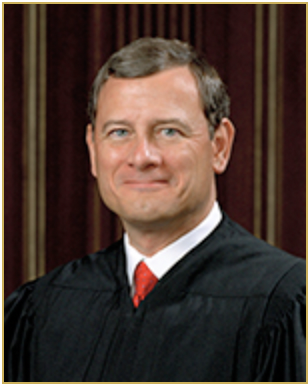
Chief Justice John Roberts, writing for the majority in 2019, said that it’s up to voters, not the courts, to deal with gerrymandering. Photo from supremecourt.gov.
Race is different. Race can be a factor in districting. Under the Voting Rights Act of 1965, states may not “illegally dilute minority voting strength.” The act dinged several states — Alabama, Alaska, Georgia, Louisiana, Mississippi, South Carolina and Virginia — for their history of drawing lines to make sure Blacks or Native Americans would never compose a majority in any district for any office. Under the act, any voting-related changes in those states and a few other jurisdictions nationwide would have to be submitted to the U.S. Department of Justice for approval. The act didn’t explicitly say districts had to be created in which minority populations were the majority of voters, but that’s what happened. All across the South, the act resulted in seats at the table for Black officials, but it’s also easy to argue that concentrating minorities also concentrated majorities. If that’s hard to follow, think about five marbles – three white and two black. If the two black marbles are put in a pocket, that leaves the three white marbles in the other pocket and, figuratively at least, in a majority position where they cater only to other white marbles.
No one can know for sure, but back in the day it was likely contemplated that maps would be drawn with what could be called natural boundaries such as creeks or rivers or major highways and county lines. There would be some attention to ideology, but terrain and factors such as urban or rural would carry the day. In more recent times, however, mapmakers have incredibly precise computerized census information. It’s not far-fetched that a generative artificial intelligence program could identify people by political party and draw lines grouping 100 percent of the like-minded. For a couple where one spouse leans left and the other leans right, a district line could go down the middle of the bedroom.
Political gerrymandering does have remedies. One would be to require the use of naturally occurring and/or recognizable boundaries. Another would be, as a few places have done, contracting out the creation of district lines – out of the hands of political bodies and to a committee not provided any history or demographic information.
The challenge, of course, is that because the Supreme Court has said ending gerrymandering is not its job, that leaves lawmakers to do it. And, well, they like things just as they are.
____________________________________________
Charles Mitchell is an associate professor in the School of Journalism and New Media at the University of Mississippi and a member of the Overby Center panel of experts.