
3 thoughts on the tragic assassination of conservative activist Charlie Kirk
By Tony Pederson
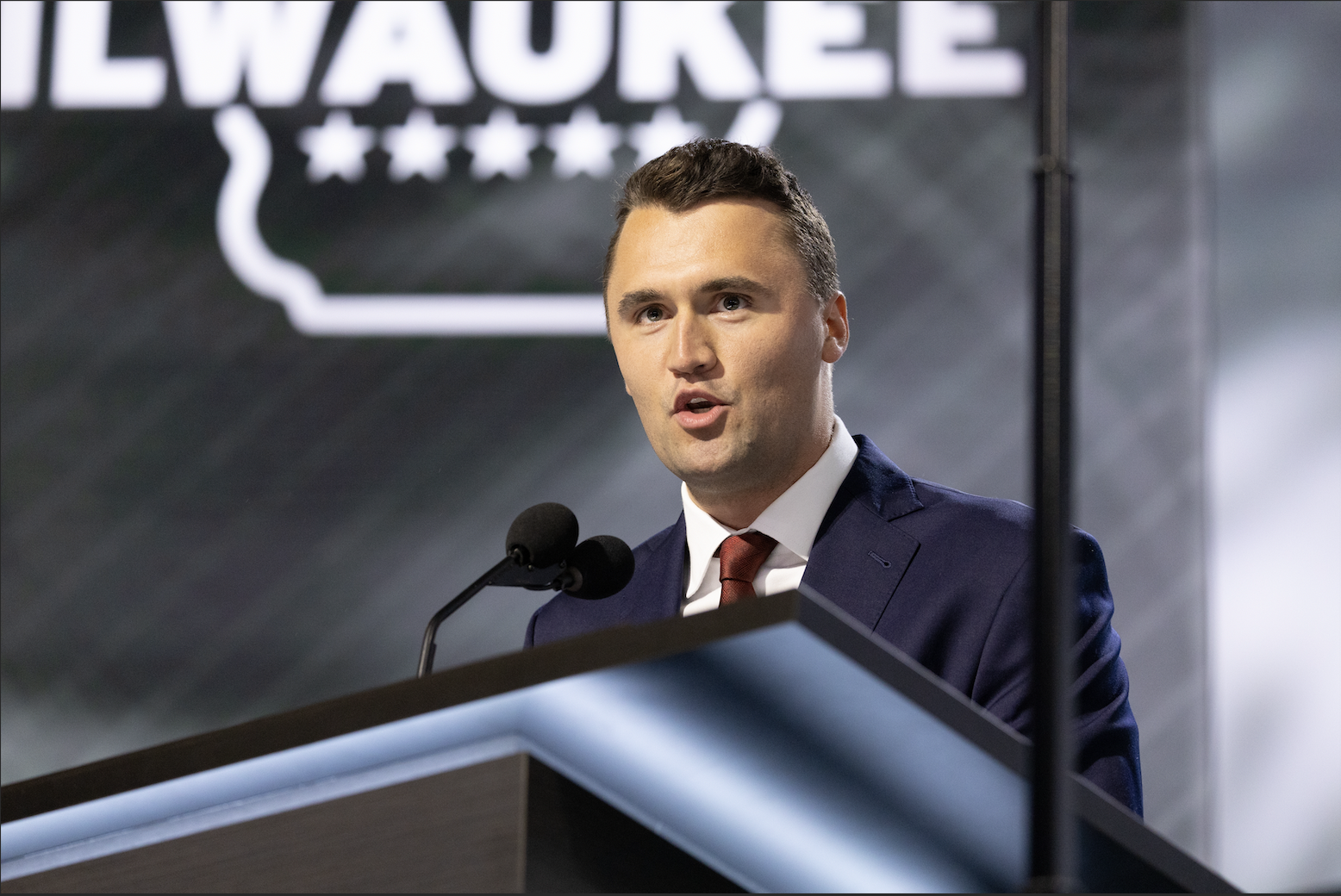
Turning Point USA founder Charlie Kirk spoke at the Republican National Convention in 2024. Photo from Shutterstock.
The murder of Charlie Kirk and the senselessness of the tragedy create a heightened sense of the possibility of more political violence. Kirk has been variously described as a right-wing provocateur, MAGA leader, and a hopeful symbol among conservative Christians of a new form of governance based on biblical standards.
His radio program and podcasts were especially popular among young Christians. He founded Turning Point USA in 2012, an organization that advocates for conservative causes with organizing emphasis in high schools and colleges. The organization’s student chapters have experienced rapid growth in recent years. Reports indicate chapter presence on some 1,100 high schools and 900 college campuses.
Kirk was 31 years old when murdered on the Utah Valley University campus by someone using a high-powered rifle. He leaves behind a wife, Erika, whom he married in 2021, and two small children.
“Charlie Kirk was a committed Christian, a devoted husband and father and an American patriot,” said Jack Graham, senior pastor of Prestonwood Baptist Church, a conservative Dallas-area megachurch. “His love for our country propelled him to be a conservative political activist who inspired a young generation to speak up for their faith and freedom. I have known Charlie for over 10 years, and I found him to be an engaging and happy cultural warrior. He was always willing to listen and to converse about the issues that matter most to our nation. He was smart, articulate and thoughtful, a true Christian thinker. Our nation mourns his loss, but I anticipate the generation he reached will rise up to continue to be a force in America for good and for God. His voice will not be silenced.”
Kirk was closely aligned with the agenda of President Trump. And he also engaged with a host of controversial ideas, including denial of the 2020 election outcome, opposition to LGBTQ rights, skepticism about climate change, and endorsement of the Great Replacement Theory, which claims that immigrants will displace white Americans. Kirk said that the Civil Rights Act was a mistake because it created a bureaucracy focused on diversity and inclusion. He criticized Martin Luther King Jr. and what he called the “myth” around the civil rights leader’s legacy.
He is being referred to as a martyr by some religious leaders. His murder is being referred to as a political assassination and is being widely condemned by politicians across the ideological spectrum. The Wall Street Journal noted in an editorial, “This is a now dangerous moment for the country, which could descend into a cycle of political violence that would be hard to arrest.”
Three things come to mind in relation to the murder and are offered here for brief mention and contemplation for the future.
First, the fact that the murder occurred on a university campus is a shock to all of us who work in academia. Universities have become a cauldron of anger and resentment over free speech. Conservative speakers have had events canceled. Some have been shouted down during appearances. The Israeli military action in Gaza has raised further questions on how far speech can go on campuses, and legitimate questions have been raised by the Trump administration regarding antisemitism at universities, including some of the top universities in the United States.
Have we lost the tradition of what a university is in the first place? What happened to the idea of letting ideas clash in a civil and respectful way? In his sustained argument against licensing, British poet John Milton gave us the historic image in Areopagitica, published in 1644: “Though all the winds of doctrine were let loose to play upon the earth, so Truth be in the field, we do injuriously, by licensing and prohibiting, to misdoubt her strength. Let her and falsehood grapple; who ever knew Truth put to the worse, in a free and open encounter?”
Universities, and even the concept of a university, are under enormous stresses, from financial to political. There is serious questioning of the value of a four-year degree. And universities are in need of rethinking some of their structures and, the most difficult aspect of any institution of higher education, curriculum. And a different level of thinking is needed for each institution to identify what its graduates will represent. But in any case, freedom of thought and freedom of expression are paramount for every university to not just tolerate but to promote. The freedom of intellectual inquiry and the freedom to pursue ideas must be central to the university experience.
Second, the marginalization and decline in the importance of mainstream and legacy media continue at a rapid pace. The success Charlie Kirk had in his rise to prominence reminds us again of the rapidly changing nature of the media landscape. He gained national prominence through a radio program and podcasts, The Charlie Kirk Show. He was active on social media and his YouTube channel. He had 5.7 million followers on X (formerly Twitter) and 9.7 million followers on Instagram. He had 3.8 million YouTube subscribers. His audiences skewed much younger than typical conservative programming, making him known and popular to Gen Z and millennials. His podcasts frequently were No. 1 on Apple Podcasts after major events.
The video of his murder, graphic and difficult to watch, immediately was available on numerous websites and social media. The Associated Press summarized the issue succinctly in a national news story. “For more than 150 years, news organizations like newspapers and television networks have long been accustomed to ‘gatekeeping’ when it comes to explicit content – making editorial decisions around violent events to decide what images and words appear on their platforms for their readers or viewers. But in the fragmented era of social media, smartphones and instant video uploads, editorial decisions by legacy media are less impactful than ever.”
Third, when will the time come for an honest national discussion on gun violence? Why can’t we have that discussion without it being a fraught political zero-sum debate that characterizes us in ways that have no relevance to real solutions. The Pew Research Center data on gun violence is shocking and sad. Thousands of families continue to be affected each year. Mental illness continues to be a factor in many cases. But what are the other issues involved in someone taking a high-powered rifle and killing a speaker at a public event? Is the heated political rhetoric we hear daily from both parties a factor?
We have become dulled to news of killings over various criminal enterprises and drug deals. Killings in schools seem to generate anger and talk, but little action. Charlie Kirk’s murder is a political assassination that appears intended to silence a messenger. If we tolerate this heinous act, democracy is even more at risk than most of us thought.
———————————————————————————
Tony Pederson is managing fellow of the Overby Center for Southern Journalism and Politics and professor emeritus in journalism at Southern Methodist University in Dallas.