
Lawmakers in a number of states are proposing ways to help local news
By Jared Schroeder
The Times-Virginian, a weekly newspaper that served central Virginia counties for more than 130 years, shut down in February. Nothing replaced it. Appomattox County, one of the two counties the newspaper served, lost its final source for local news. Appomattox County isn’t alone, more than a quarter of Virginia newspapers closed between Northwestern University’s Medill State of Local News reports in 2024 and 2025. The loss is part of a continuing trend of expanding news deserts, both in the South and throughout the United States. More than 50 million Americans now have little or no access to local news.

The Times-Virginian was a weekly newspaper that had served central Virginia for more than 130 years.
While the Times-Virginian’s story, and that of other similar news outlets, might sound like a business model problem, it’s far more impactful than that. Citizens don’t simply lose a news source when a newspaper shuts down. They lose a part of the glue that holds their community together. Studies have shown that loss of local news coverage leads to declines in voter engagement and knowledge, accountability for politicians, and shared local pride. Communities, in other words, lose part of themselves when they lose access to local news.
As community newspaper owners and new startups are finding some success in pushing back against expanding news deserts, state lawmakers have started to take notice of what communities lose when they lose access to local news. A recently created resource at the Missouri School of Journalism’s Reynolds Journalism Institute found lawmakers in eighteen states have proposed more than 60 bills in the past several years to help support local journalism. Only two of those bills were proposed in the South. Concerningly, lawmakers in Southern states have been eerily quiet as a crucial, democracy-supporting institution has faded in their districts.
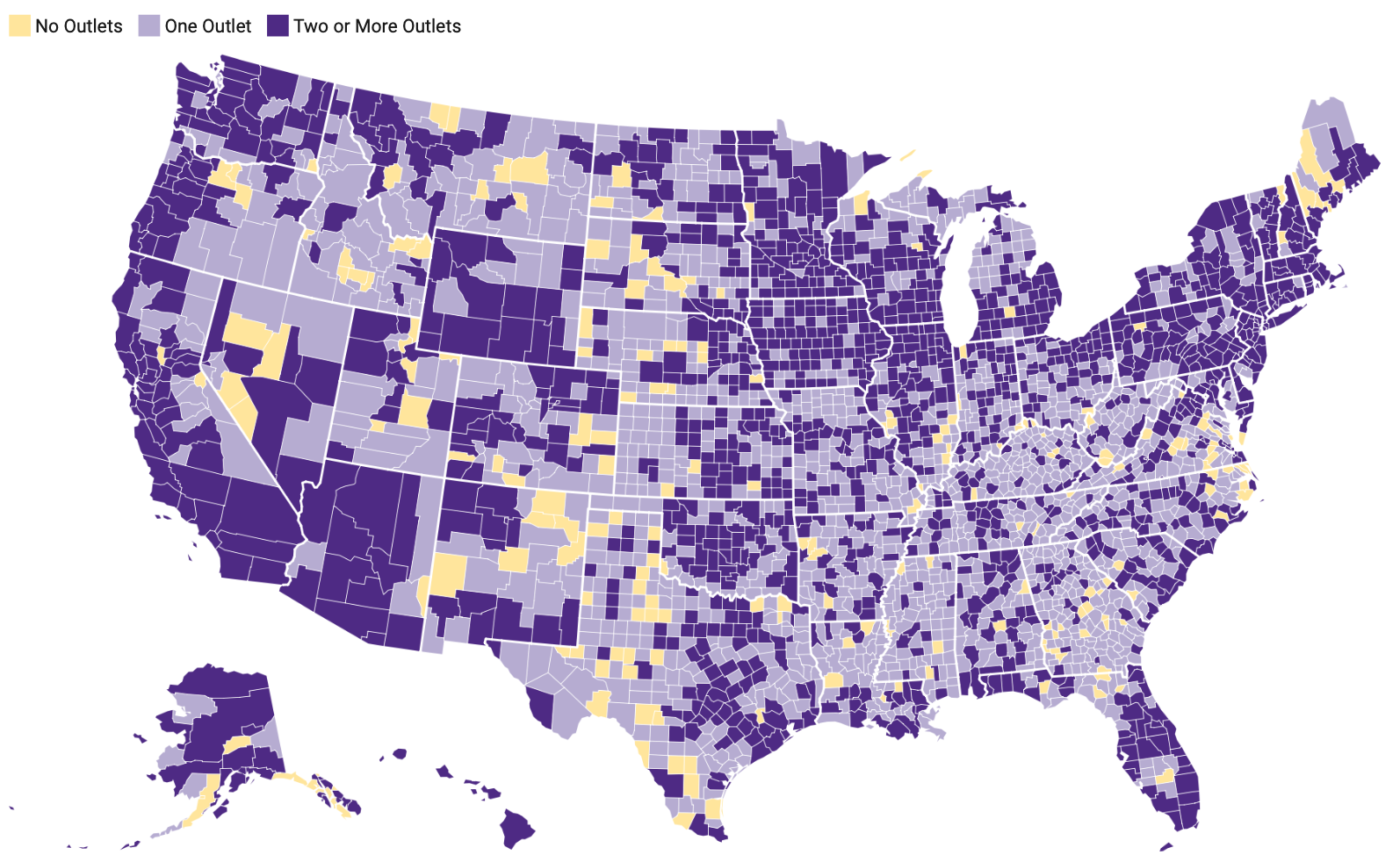
This graphic shows the areas in which there is little or no access to local news. Graphic by Northwestern Medill Local News Initiative.
This bill-filing season presents an opportunity for state lawmakers in the South to consider some of the policy models other states are considering and implementing to support local news, as a democratic and public good, in their communities.
The policy efforts other regions are considering take several forms, all of them with generally strong protections for retaining journalistic independence. Lawmakers in six states, for example, considered laws that require state agencies to spend certain percentages of their annual advertising budgets with local newspapers. This would mean state health or education agencies, for example, spend money to advertise locally rather than send taxpayer money to national or international corporations, like TikTok or Facebook.
This solution benefits the entire state. It supports local journalism by increasing advertising revenues and keeps more taxpayer money in the state and in local economies, rather than leaving to line the pockets of social media firms like Instagram and YouTube. Connecticut’s bill, which was unsuccessful during the
2025 legislative session, required 15 percent of the state’s annual budget be spent with local publishers. Maryland proposed 50 percent in its bill, which was also considered this year.
Other states have provided grants and fellowships to help support local news coverage. New Jersey has provided the most successful version of this model. The state created the New Jersey Civil Information Consortium in 2018. The non-profit, grant-making organization is led by a 15-member voting board, which awards grants that help support local journalism. Similarly, Washington state lawmakers provided funding in 2024 to set up a fellowship program, administered by the Edward R. Murrow College of Communication at Washington State University, to fund placing local journalists in newsrooms throughout the state. Illinois set up a different system, passing a law that created a classroom-to-newsroom program that provides scholarships for students to study journalism in Illinois and, in return, they are required to work in local newsrooms in the state for at least two years after they graduate.
Using a different approach, lawmakers in several states have proposed tax credits and exemptions to support local journalism. Earlier this month Missouri State Sen. Jamie Burger filed a bill for the state’s upcoming session that would provide a tax credit for 50 percent of the compensation for newspaper pressroom and mailroom staff. New York lawmakers passed a similar law in 2024, but it focused on hiring journalists, providing tax credit for publishers that covers half of a journalist’s salary. These tax credits help make news operations sustainable, hopefully limiting the number of expanding news deserts.
Importantly, there’s not one solution to the consistent loss of access to local news that many Americans, particularly those who live in rural communities, face. What is crucial is that lawmakers in a diverse set of states in most regions of the U.S. have recognized the problem and are experimenting with solutions.
Upcoming legislative sessions provide a new opportunity for lawmakers in the South to refine and pass laws that support local news organizations and, as a result, support democracy and enhance community in their states.
———————————————————————————
Jared Schroeder is an associate professor at the Missouri School of Journalism and a member of the Overby Center panel of experts. He and Zivile Raskauskaite, a doctoral candidate, created the new resource that tracks legislative efforts to support local journalism, which is hosted by the Reynolds Journalism Institute.
