
Banking on local news: JPMorgan Chase CEO touts value of community journalism at Mississippi Today event
By Jake Batsell
JACKSON, Miss. — Local journalism is essential for effective small-d democracy, the head of the world’s largest bank repeatedly told an overflow crowd of Mississippians last week.
“I’m a big supporter of the news, even when they write stuff I don’t like,” JPMorgan Chase CEO Jamie Dimon said during a Q-and-A session at the Mississippi Museum of Art. “It’s foundational to democracy.”
Paying for the watchdog reporting that informs our democracy is a thornier matter, especially at a moment when funding for independent media is threatened on multiple fronts. But in the Magnolia State, Dimon’s company is partnering with a Pulitzer Prize-winning newsroom as part of a nationwide experiment that aims to shore up more financial support for local news.
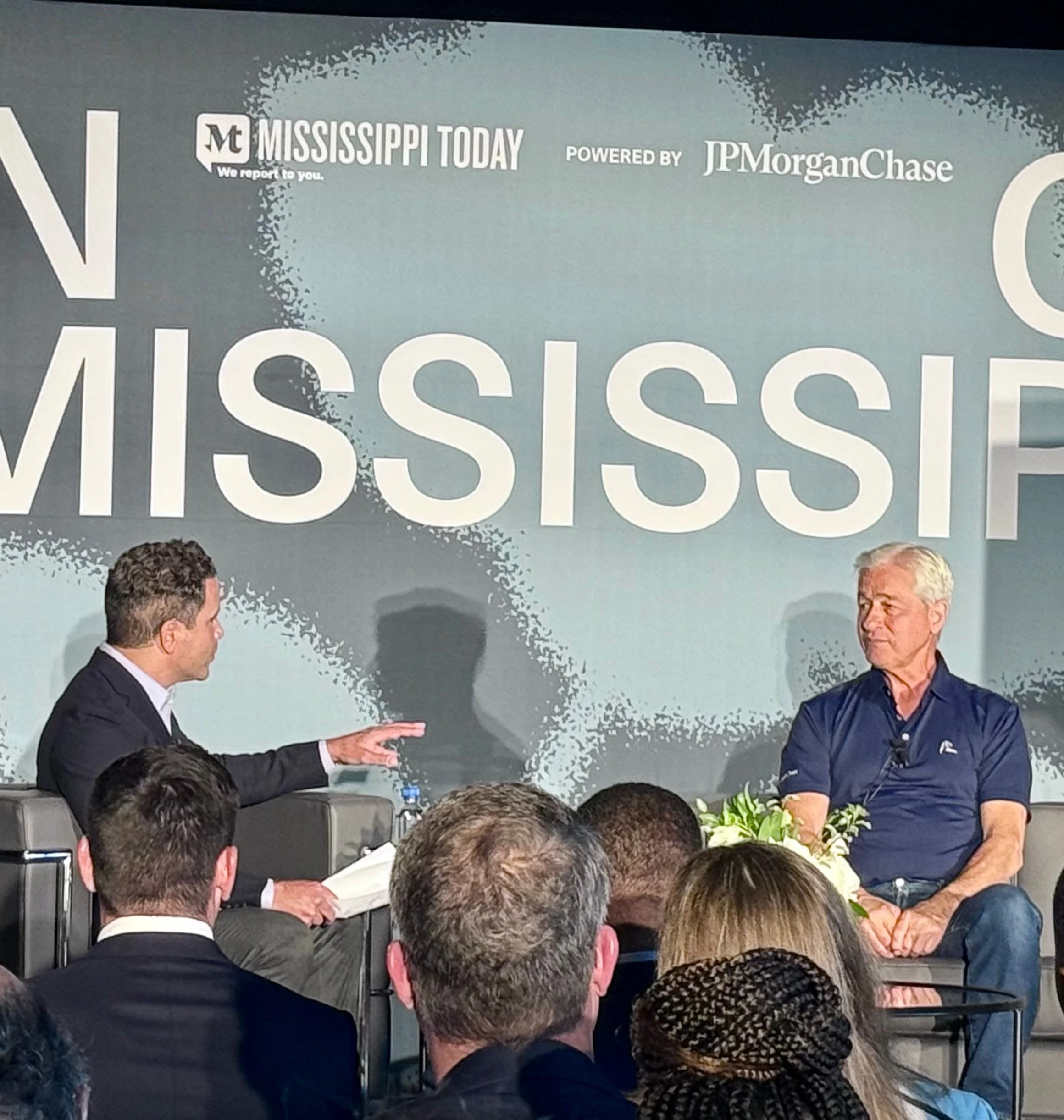
JPMorgan Chase CEO Jamie Dimon (right) fields a question from Deep South Today CEO Warwick Sabin during the “All In on Mississippi” event in Jackson on July 28. Photo by Jake Batsell
Dimon was the headliner for “All In on Mississippi,” a half-day economic development summit in downtown Jackson backed by JPMorgan and seven local sponsors. The July 28 event, hosted by Mississippi Today and JPMorgan, was part of the megabank’s two-year, $2.6 million commitment to help a selected cohort of U.S. nonprofit news outlets build business capacity with assistance from the American Journalism Project, a venture philanthropy organization.
Mary Margaret White, Mississippi Today’s CEO, said her organization received a $98,000 grant through the partnership for publishing sponsored content authored by JPMorgan and teaming up on the event.
Beyond the financial boost, White hopes events like “All In” will help Mississippi Today build goodwill as a community convener. The digital nonprofit newsroom, which launched in 2016 and won the 2023 Pulitzer Prize in Local Reporting, recently moved its headquarters from suburban Ridgeland to downtown Jackson near the state Capitol.
As Mississippi Today approaches its 10th anniversary next spring, White told me, “We really want to cement ourselves as a cornerstone for good journalism here in Jackson” and across the state. Hosting more public conversations is a big part of that strategy.
“As much as our goal has been to build an informed Mississippi, because we think that is a stronger Mississippi, as we grow and evolve as a newsroom, I think we put nearly as much value on being a convener in the community,” White said.
“All In” brought together about 250 business leaders, policymakers, journalists and others for frank dialogue about some of the state’s most pressing economic challenges. Panels focused on the state’s “brain drain” problem, strengthening downtown Jackson’s local economy, and an interview with Mississippi billionaire Tommy Duff, who is mulling a gubernatorial run.
For the marquee event, Dimon was interviewed by Warwick Sabin, CEO of Deep South Today, parent company of Mississippi Today and its New Orleans-based sister publication, Verite News. And when audience members posed questions, they did not lob softballs, instead asking Dimon to address topics ranging from rising income inequality to whether he plans to bring a regional office to Jackson.
It was a candid and direct dialogue. When newsrooms pursue sponsored events as a dedicated revenue strategy, they can’t be empty public relations exercises, as some of my past research has shown. Dimon’s appearance was tied to an annual company bus tour across the South, but the rest of the program’s design “was strictly in the hands of our editorial team,” White said. That newsy approach kept the tone substantive throughout the afternoon.
Setting boundaries for editorial independence is equally paramount when it comes to sponsored content, also known as native advertising, which more closely resembles the format of news coverage than conspicuous ads. Thus far, the bank’s sponsored pieces published by Mississippi Today have focused on financial literacy topics and are clearly labeled as “paid for and written by JPMorganChase.”
So how does JPMorgan benefit from the partnership? Elaborating on Dimon’s earlier small-d democracy remarks, Andrew Gray, the company’s managing director of regional communications, pointed out that robust local news is proven to foster deeper civic participation, higher voter turnout and less corruption. All these factors, he said, contribute to a strong economy — which, of course, is important for a bank.
“We need local news in order to tell stories about the work that we're doing, and that starts at the local level in the community,” Gray said. “We can't do that through The Wall Street Journal or Bloomberg or Reuters or whatever, so we have an interest in a strong local news environment.”
White said JPMorgan’s credibility with the local business community brings potential to attract more corporate partners as Mississippi Today seeks to further broaden its revenue sources beyond philanthropic giving. Traditionally, she said, the site’s nonprofit business model has consisted of roughly 50% foundation grants, 30% major donations and 20% memberships. Going forward, the goal is to add more so-called “earned revenue” to that mix through sponsored events and corporate underwriting.
Mississippi Today’s quest to beef up earned revenue reminds me of The Texas Tribune’s earlier evolution to diversify its funding sources. Just over a decade ago, I spent a year based in the Tribune’s Austin newsroom as part of a Knight Foundation fellowship to research best practices in the business of digital nonprofit news. As I later observed in my fellowship report for Knight, the Tribune relied primarily on donations in its early years before adopting a more “aggressively entrepreneurial” strategy fueled by corporate sponsorships and underwriting.
Patty Slutsky, the American Journalism Project’s chief advancement officer, said AJP is pleased with Mississippi Today’s financial progress as it continues to grow. Since 2019, AJP’s investments in Mississippi Today and the Deep South Today network have totaled $3.75 million. During that same five-year window, Mississippi Today’s overall revenue (excluding AJP’s investment) jumped from roughly $1.6 million in 2019 to $3.3 million in 2024.
“They’ve doubled their revenue and they’re building basically now what is the largest newsroom in Mississippi,” Slutsky said. “That’s really exciting.”
Given that trajectory, Mississippi Today was a natural fit for the AJP-led partnership with JPMorgan, which began last year with seven nonprofit newsrooms across the country and expanded to three others in May. The partnership’s main objective is to “strengthen the financial resilience of nonprofit local news” by helping these outlets develop business and operational capacity while diversifying their revenue streams.
Investigative newsrooms partnering with megabanks, on its face, seems counterintuitive. It certainly marks a departure from the arms-length, transactional advertising that paid the bills during the heyday of legacy media.
But during a week that ended with the gut punch of the Corporation for Public Broadcasting’s announcement that it will shut down operations —not to mention the ongoing plagues of news deserts and vulture funds — the “All In on Mississippi” event offered a glimpse of hope for the future sustainability of local news. With the proper editorial safeguards to ensure journalistic independence, similar partnerships with deep-pocketed corporations could be one promising path forward.
“I think we need many more corporations to come to the table,” Slutsky said. “That's definitely a huge piece of the sustainability puzzle for these outlets.”
——————————————————————————————
Jake Batsell is an associate professor and the William J. O’Neil Chair in Business Journalism at Southern Methodist University in Dallas. His latest research project focuses on emerging community-driven strategies to fund local news.