
100 years of scholastic journalism education and the honor of a lifetime
By R.J. Morgan
It was just dawning spring when we gathered in New York City in March, in a heavily windowed room inside Pulitzer Hall at Columbia University, for the annual ritual of the Columbia Scholastic Press Association awards luncheon.
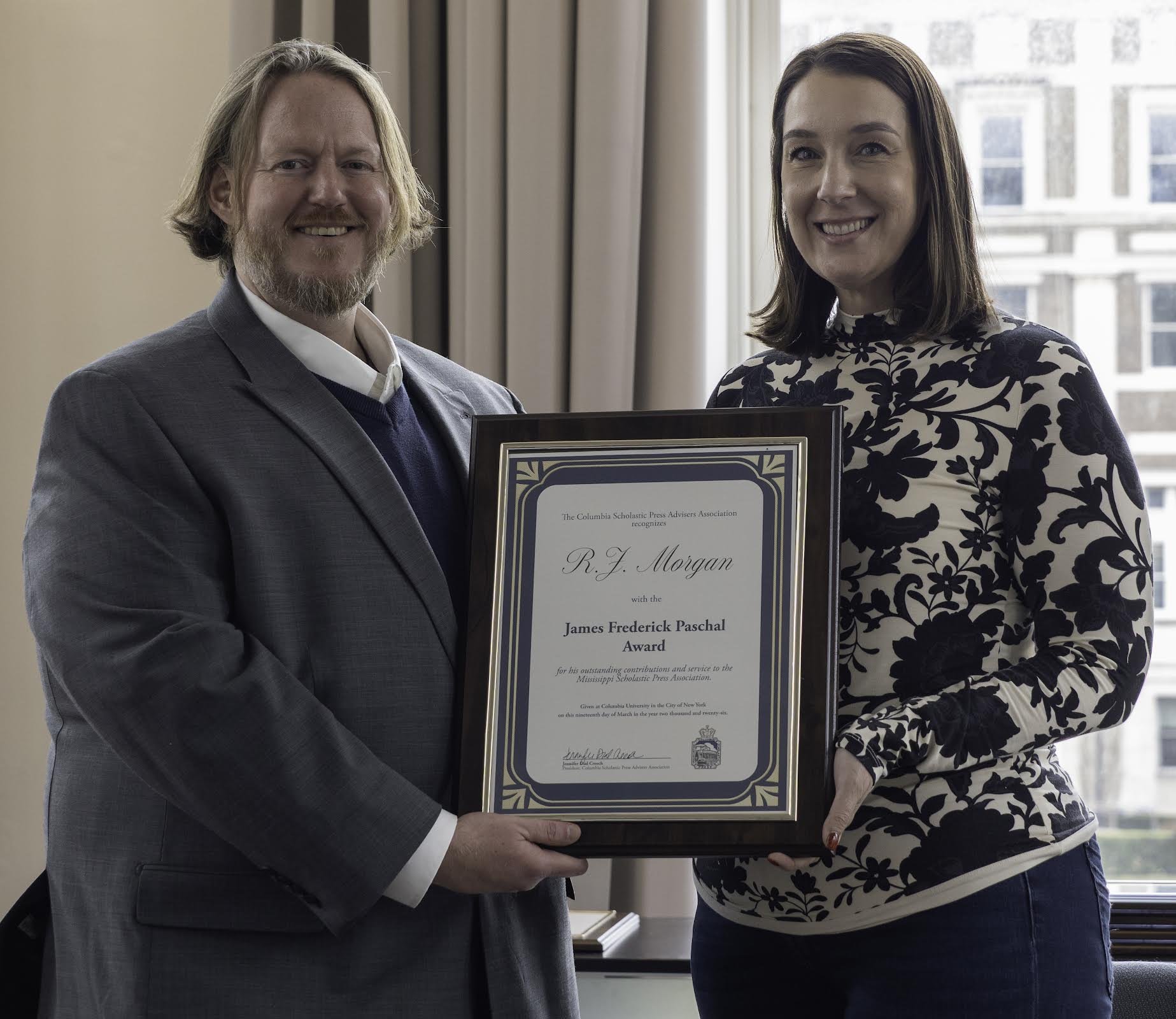
Jenny Creech, president of the Columbia Scholastic Press Advisers Association, presents Dr. R.J. Morgan, MJE, with a plaque for the 2026 James F. Paschal Award at the CSPA Awards Luncheon in New York City on March 19. Photo by Mark Murray.
As I do every year, I sat and watched as several excellent teachers were feted with Dow Jones National High School Journalism Teacher of the Year honors, Gold Key Service Awards, etc. This year I was also there to receive the CSPA James F. Paschal Award for excellence in scholastic press leadership, which is somewhat of a lifetime achievement award for a scholastic press director. (You can only win it once, and it’s only been awarded 30 times since 1987.)
It was a meaningful moment. I’ve been director of the Mississippi Scholastic Press Association for 13 years now, and I founded the Integrated Marketing Communication Association in 2022. Scholastic journalism has, in many ways, come to define my life. I am not alone in that regard.
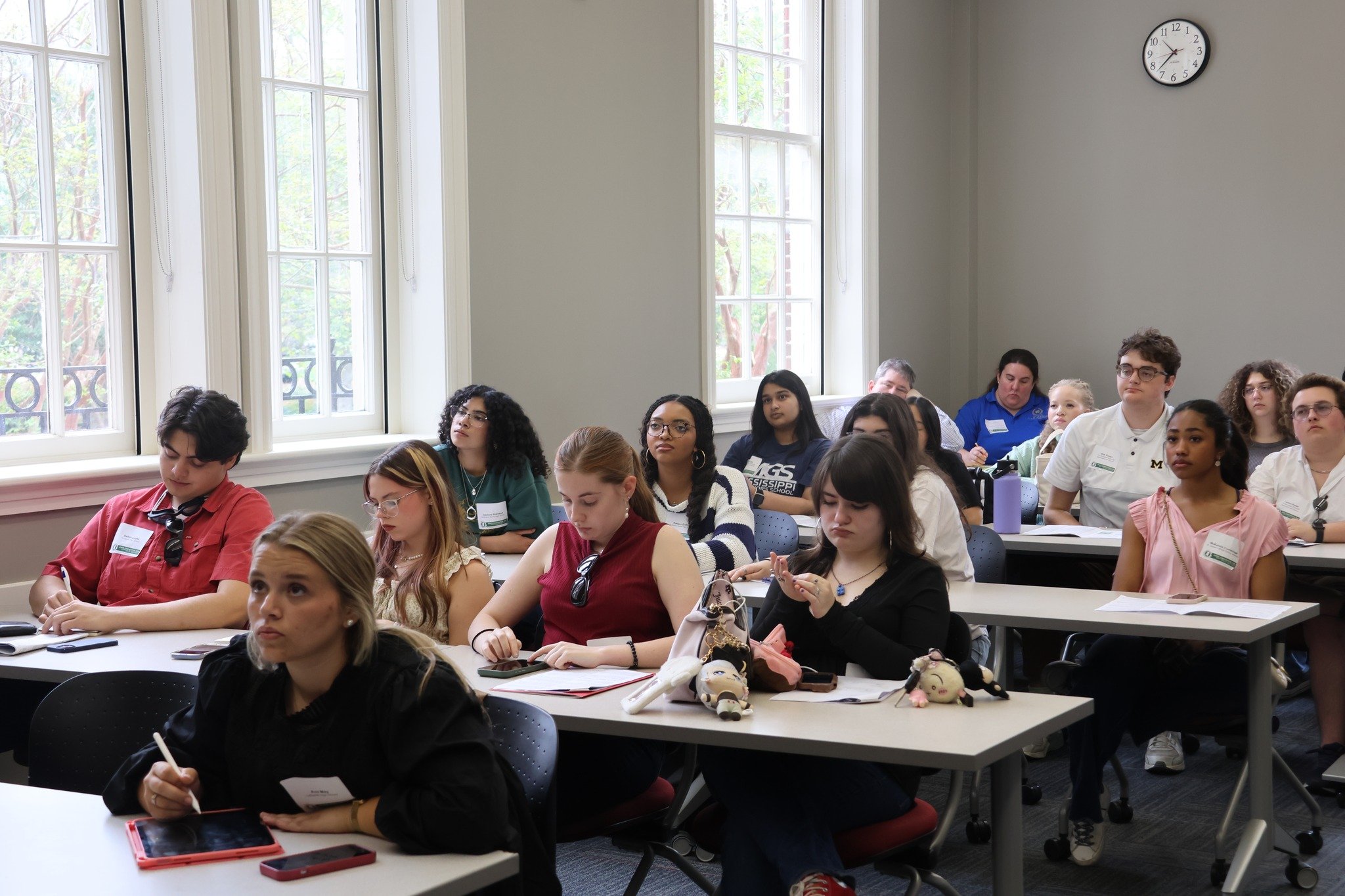
Four hundred and eighty-two students from across Mississippi attended MSPA Spring Statewide Convention at the University of Mississippi on March 31. Photo by Veronica Flores.
The room was full of friends and educators from across the country, united by our belief that high school journalism changes students’ lives and strengthens our democracy. As I ate my dessert, I began reflecting on the wisdom, some 100 years ago, of creating such associations in the first place.
“Among the unheralded heroes of American journalism are the founders of high school press associations,” researcher Lawrence Campbell wrote in 1967. “These pioneers explored new frontiers of learning.”
He couldn’t be more right, and future scholars owe a great debt of gratitude to Campbell, Bruce Konkle and others for their work in preserving the legacy of this unique strand of American history.
Scholastic press associations were created during a very specific moment, in response to a changing world. America before the 1920s was sharply agrarian. Schooling was important, but other than covering what was absolutely necessary (think reading, writing and ‘rithmetic), most young people were needed back home with their parents as soon as possible.
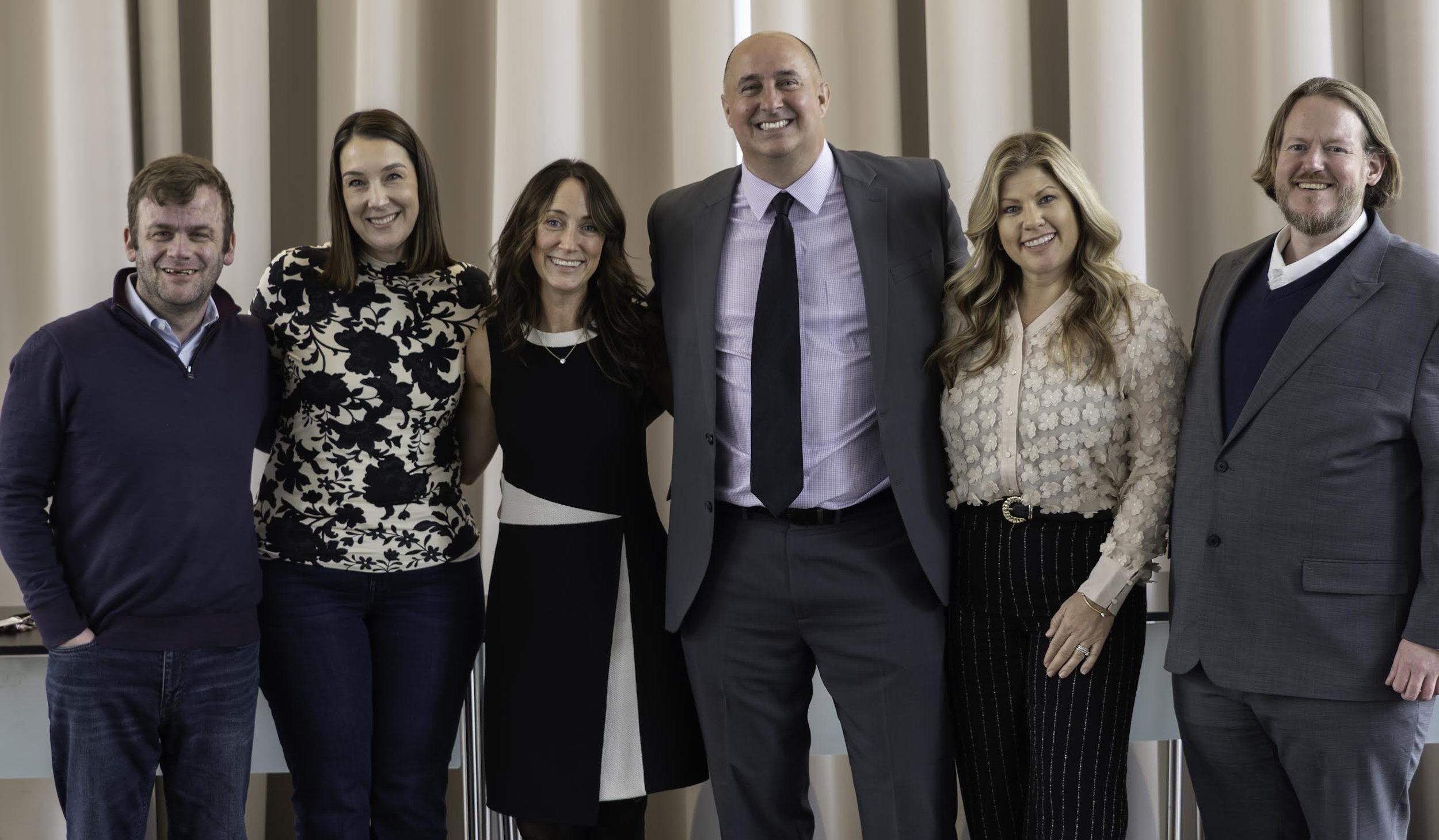
David Cutler (Brimmer and May School, Massachusetts), Jenny Creech (St. Mark's School of Texas), Tracy Anderson (Community High School, Michigan), Larry Steinmetz (Bullitt East High School, Kentucky), Kori James (Fresno Christian School, California), and R.J. Morgan (University of Mississippi) were among the individual honorees at the 102nd Columbia Scholastic Press Association Spring Convention in New York City on March 18-20, 2026. Photo by Mark Murray.
Then came the Industrial Revolution. Henry Ford installed his first assembly line on Dec. 1, 1913, and the need for American factory workers skyrocketed from there. The changing economy pulled fathers out of the fields and into factories. First-wave feminism meant more mothers were joining the workforce, too. What America needed from its schools began to change.
Instead of rushing through the curriculum and dismissing by lunch, parents now needed the school day to stretch into some reasonable approximation of a factory workday. Elective courses and after-school activities helped keep students engaged on campus instead of returning home or getting into trouble elsewhere.
This first wave of school activities settled into three main prongs: sports, student government and student media. All three remain touchstones of the American high school experience today.
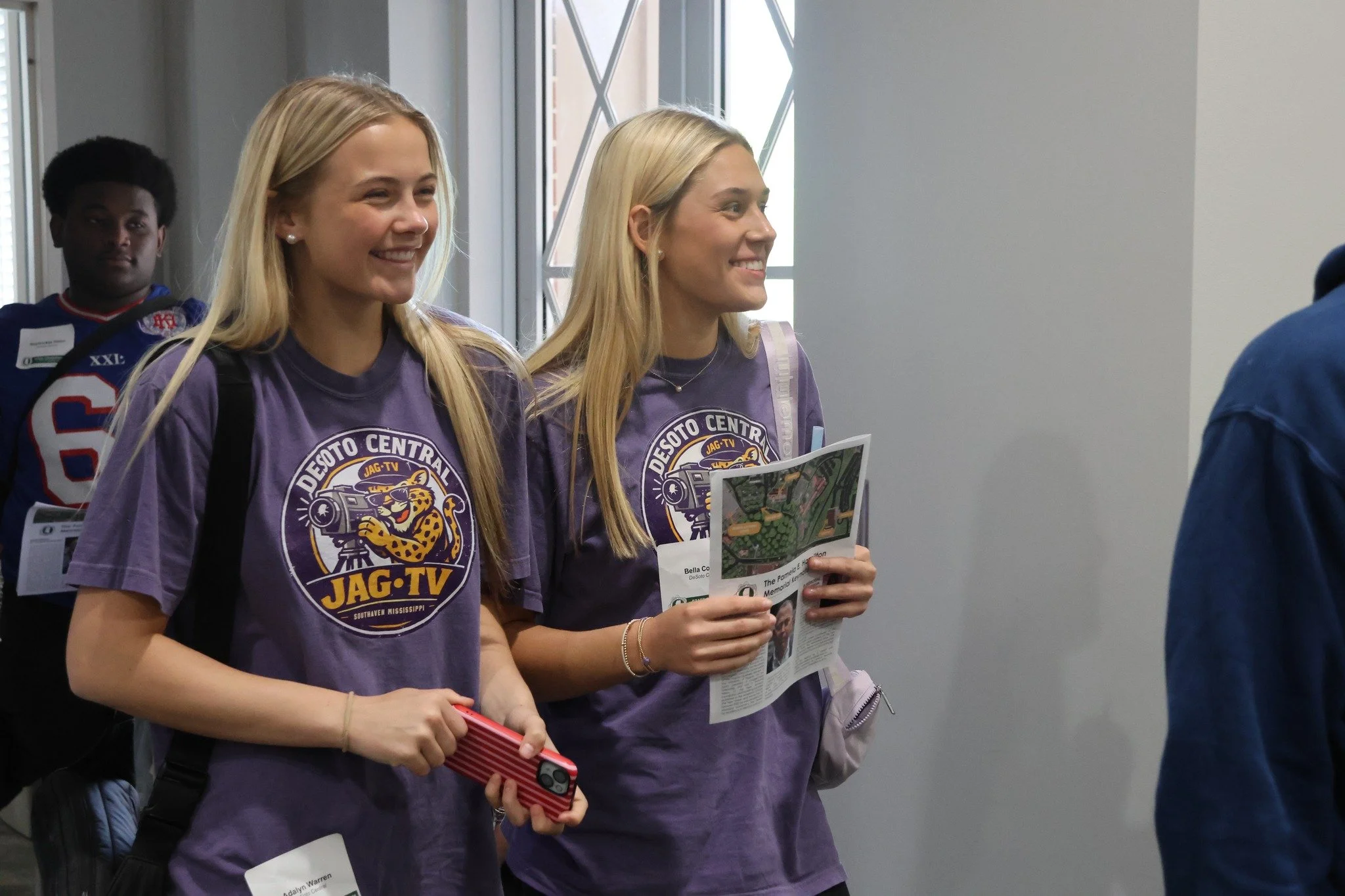
Students from Desoto Central's Jag-TV were all smiles during a class change at this year's MSPA Spring Statewide Convention. Twenty-four schools attended the event. Photo by Veronica Flores.
Around the same time, universities were beginning to grapple with journalism as an emerging discipline. Washington College in Virginia (founded by Robert E. Lee and eventually renamed Washington and Lee University) offered the first classes in journalism education in the mid-1860s, immediately after the Civil War, but the concept didn’t gain much traction until the University of Missouri founded the first school of journalism in 1908. Then the race was on.
The ethos of journalism education in those days was professional practice. Students should learn by doing, even at an early age. So public universities responded to the needs of their tax-paying constituents by organizing and funding scholastic press associations to engage pre-college students through contests, conventions and some form of unified communications (newsletters).
The concept exploded. Within 25 years, almost every state had one. The Montana Scholastic Press Association was founded in 1915, then paused operations until after World War I. The Oklahoma Scholastic Press Association is the oldest continuously operating association, founded in 1916. My own state’s association was founded at Ole Miss in 1947, the same year the university launched its journalism department.
“The rapid growth of the high-school newspaper between the years 1920 and 1940 was not accidental,” a 1950s textbook claims. “The educational values of the project, once recognized, caused the movement to sweep the country like wildfire. Half of the school newspapers that exist today had their origin during those twenty years. This growth has come because student journalism presents a field of worthwhile endeavor that is alive and stimulating, one in which students like yourself can see themselves develop through meaningful educational activities.”
These associations were mutually beneficial. Students and teachers gained specialized knowledge and the ability to adapt to new trends. They also got a formal clearinghouse for honoring student work. Universities earned an improved reputation for serving the public and a higher profile with potential recruits. Even today, one of the specifically named items in the standards of the Accrediting Council of Education in Journalism and Mass Communication is (8d), “The unit supports scholastic journalism.”
As state organizations began to proliferate, national and regional associations entered the chat and further legitimized the field. The National Scholastic Press Association launched in 1921. The American Association of Teachers of Journalistic Writing in Secondary Schools followed in 1924 and was thankfully renamed the Journalism Education Association in 1963. Columbia launched CSPA in 1925. The Quill and Scroll International Honorary Society for High School Journalists was established at the University of Iowa in 1926, the same year Washington and Lee founded the Southern Interscholastic Press Association.
Inside of a decade, a robust national ecosystem had cropped up, built to support state-level orgs and individual student publications in high schools across the country. Such a meaningful investment of time and resources is a debt modern practitioners struggle to repay. There was a realization there, generations ago, that autonomous school news labs were important institutions, and they were worth preserving.
One hundred years later in 2026, scholastic journalism again finds itself at the center of a changing world. Censorship on and off campus is rampant. In its most recent Where America Stands survey, the Freedom Forum (a 1991 spinoff of the Gannett Foundation) found that Gen Z students were more than twice as likely as Baby Boomers to fear being fired for something they said. The Student Press Law Center, founded in 1974, just released its strategic plan for 2026-28, which calls for scaling up its services to meet increasing demand.
Thinking about the last hundred years of student media inevitably led me to thinking about the next hundred. Will there still be formal student media programs in 2126? Will there still be journalists? Will there still be public high schools?
Or will all of this go the way of the fur trader: a fine, prolific way to make a living for 100 years or so, then no longer relevant to modern life.
For obvious reasons, it’s hard to say. But I posed this question to some of the sitting directors of these institutions, and their answers are illuminating.
“Further individualization of the news,” Quill and Scroll director Lori Keekley said. “I anticipate media consumption will be so fine tuned to the person that no two feeds will be the same. It will still be important for all consumers to evaluate sources of news — and it will be important for people to still be part of the gathering of news.”
JEA director Veronica Purvis expects journalism to “be more integrated with other subjects and skills” and to exist at “an even faster pace with more technology and tools speeding up content creation, editing and producing.”
Purvis worries about journalistic credibility and the public’s ability to discern fact from fiction as the amount of misinformation available online continues to grow thanks to Artificial Intelligence.
“But still incredibly valuable and important regardless of the AI/technology advances,” Purvis said. “Teachers and students will become more proficient in the whole process.”
SIPA director Nina Brook predicts we will still recognize a lot of what’s going on in scholastic journalism a century from now.
“At its heart, scholastic journalism is young people telling other young people the stories of our communities,” Brook said. “We may not recognize the technologies and platforms that will be used for that future storytelling, and that’s as it should be. As we launch the next 100 years of storytelling, we must allow our student media to evolve and make progress while remaining true to the core mission.”
To close, I will give the final word on this topic to Peter Bobkowski, surely one of the most knowledgeable and well-reasoned voices in our profession. Peter started his career as a publications adviser and has been researching scholastic journalism at the collegiate level since 2011. First at the University of Kansas, and since 2023 at Kent State University, where he serves as Knight Chair and directs the Center for Scholastic Journalism.
In trying to sum up where we go from here, Peter writes:
Disclaimer: I am not a futurist, that is, someone who’s able to imagine a future that’s different from what we experience today. For example, when someone told me in the 1990s that one day a desktop computer will contain an entire library of books, I couldn’t comprehend how the librarian and the stacks would get shrunk to fit inside a computer.
That said, it’s clear that generative AI technologies that are in their nascency today will revolutionize education and, with it, journalism education. Similarly, while I can’t predict how the production, distribution and consumption of news will change over the next 100 years, these practices undoubtedly will evolve. And even if journalism and journalism education are called something different in 100 years, someone will still be teaching young people two competencies that are at the core of journalistic practice today: how to establish the veracity of information and how to tell authentically human stories.
We all know that the flood of AI slop is only going to intensify. Assuming that the problem of low-quality, synthetic and misleading information isn’t somehow solved in the next 100 years, we will continue to need young people who know how to tell apart facts from not-facts, and to explain this difference to their peers. We will also need young people who know how to talk to one another and to convey to their communities the stories of their peers’ joys, sorrows, and mundane everyday experiences.
So verification and human storytelling are the two skillsets that journalism education will excel at 100 years from now. There may be more than these two—remember, I’m not good at telling the future. But even if it’s just these two, journalism education will continue being one of the most efficient ways to help students understand and communicate with the world around them.
For the sake of the kids, I surely hope he is right.
––––––––––––––––––––––––––––––––––––––––––––––––––––––––––––––––––––––––––––
R.J. Morgan is an instructional professor in the School of Journalism and New Media at the University of Mississippi, director of the Mississippi Scholastic Press Association and a member of the Overby Center panel of experts.
